
















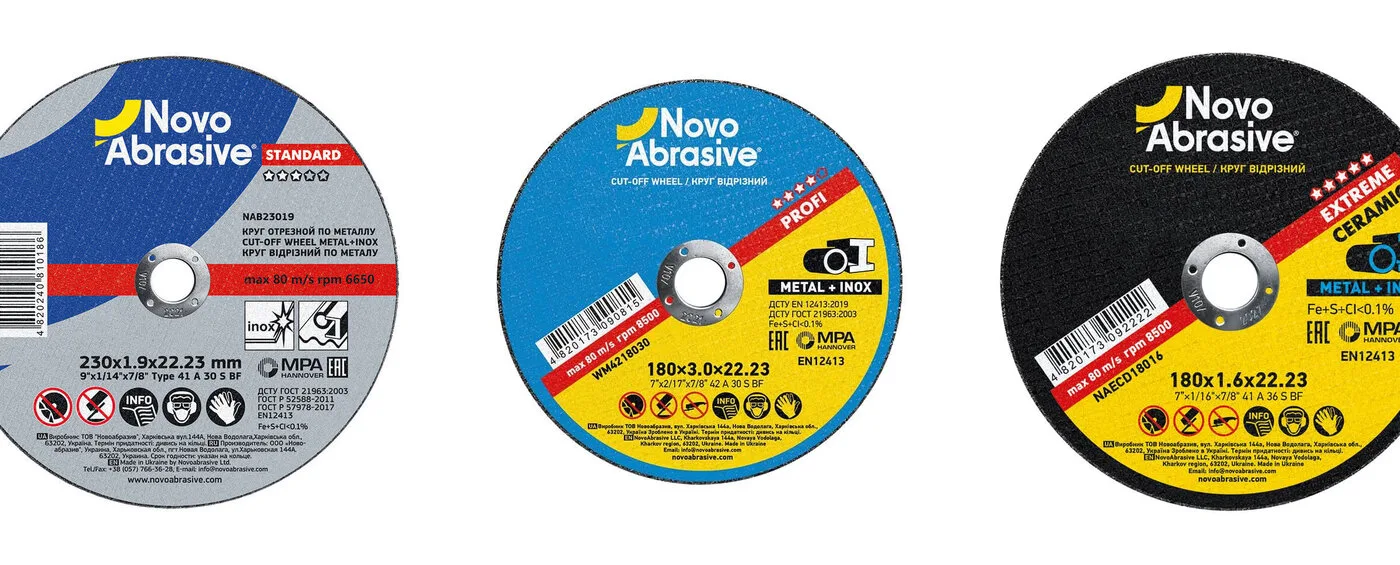
In old catalogues, in warehouses and in process sheets the "GOST" marking lives on: 14А 40 СТ3 7 БУ. Modern discs carry the short European code A 30 S BF. Both describe the same thing — material, grain, hardness, structure and bond — but in different scales that do not convert one to one without caveats. Below are both systems and approximate correspondence tables.
Old marking: 14А 40 СТ3 7 БУ
The GOST 2424 system (and its related standards for grain and hardness) described a disc as a string of fixed positions; cutting discs had their own GOST 21963 with the same designation system. Let us look at a typical resin-bonded disc:
- Material was coded with a number and a letter: 13А–16А — regular aluminium oxide, 22А–25А — white, 37А–38А — zirconia, 52С–54С — black silicon carbide, 62С–64С — green.
- Grit size per GOST 3647 is a number equal to the lower sieve size in tens of micrometres: 40 means a 400–500 µm grain. The larger the number, the coarser the grain — the opposite of the FEPA scale.
- Hardness— letter groups from ВМ (very soft) through М, СМ, С, СТ, Т to ВТ and ЧТ (extremely hard), with a numeric index within the group.
- Structure 1–12: the higher the number, the more open the structure (less grain, more pores).
- Bond: К — vitrified, Б — resin, БУ — reinforced resin (the one used in cutting and grinding discs), В — rubber.
- Grinding wheels also carried an accuracy class (АА, А, Б) and an unbalance class (1–4).
New marking: 41 A 30 S BF
The European standard EN 12413 (in Ukraine — DSTU EN 12413) kept a short FEPA-system code from the specification. On a NovoAbrasive cutting disc it looks like this:
But the code itself is only one of the twelve mandatory label elements: alongside it the standard requires the trademark, dimensions, maximum speed in m/s and rpm, application, safety pictograms, a reference to EN 12413 and the expiry date. The full breakdown is in the guide "Abrasive disc marking EN 12413".
Table: grain material
| GOST | Material | FEPA / EN 12413 | Where it is used |
|---|---|---|---|
| 13А, 14А, 15А, 16А | Regular aluminium oxide | A | Cutting and grinding discs for steel |
| 22А, 23А, 24А, 25А | White aluminium oxide | A (often WA at manufacturers) | Grinding hardened steels, tools |
| 37А, 38А | Zirconia aluminium oxide | Z / ZA | Heavy stock removal, flap discs |
| 52С, 53С, 54С | Black silicon carbide | C | Discs for stone, concrete, cast iron |
| 62С, 63С, 64С | Green silicon carbide | C (GC) | Carbide, glass, ceramics |
The second digit of the old code (14А versus 15А) denoted the purity and production method of the material — the FEPA code has no such detail, it goes into the manufacturer's internal specification.
Table: grit GOST 3647 → FEPA F
This is the trickiest conversion, because the scales run in opposite directions: in GOST the number grows with the grain, in FEPA it grows as the grain gets finer. The correspondence is approximate — the sieve intervals do not match exactly:
| GOST 3647 | Grain size, µm | FEPA F (approx.) | Typical application |
|---|---|---|---|
| 63 | 630–800 | F24–F30 | Grinding discs 6.0–8.0 mm (NovoAbrasive — A 24) |
| 50 | 500–630 | F30–F36 | Cutting discs 2.0–3.0 mm (A 30), stock removal |
| 40 | 400–500 | F36–F40 | Cutting discs 2.0–2.5 mm, rough cutting |
| 32 | 315–400 | F46 | Cutting discs 1.0–1.6 mm (A 46) |
| 25 | 250–315 | F54–F60 | Thin cutting discs 0.8–1.0 mm (A 60) |
| 20 | 200–250 | F70 | Thin discs, finish cutting |
| 16 | 160–200 | F80–F90 | Finishing grinding |
| 12 | 125–160 | F100–F120 | Finishing grinding |
| 10 | 100–125 | F120 | Fine grinding |
| 8 | 80–100 | F150 | Fine grinding, finishing |
| 6 | 63–80 | F180 | Fine grinding, finishing |
| 5 | 50–63 | F220 | Fine grinding, finishing |
Table: hardness and bond
The hardness of a disc is not the hardness of the grain but the strength with which the bond holds the grain. Both scales describe it with letters, but GOST divides the range into groups with indices and FEPA into letters from A to Z. The group names in the two systems are shifted: what GOST called "very hard" (ВТ) is the R–T zone, "medium-hard", in European catalogues:
| GOST | Name per GOST | FEPA (approx.) | Group per EN 12413 |
|---|---|---|---|
| ВМ1, ВМ2 | Very soft | E–F | Soft (A–H) |
| М1, М2, М3 | Soft | G–I | Soft (A–H) |
| СМ1, СМ2 | Medium-soft | J–K | Medium (I–Q) |
| С1, С2 | Average | L–M | Medium (I–Q) |
| СТ1, СТ2, СТ3 | Medium-hard | N–P | Medium (I–Q) |
| Т1, Т2 | Firm | Q–R | Medium / medium-hard |
| ВТ1, ВТ2 | Very hard | S–T | Medium-hard (R–T) |
| ЧТ1, ЧТ2 | Extremely hard | U and above | Hard (U–Z) |
Resin-bonded cutting discs sit in the upper part of the scale in both systems: in FEPA it is the R–T zone (NovoAbrasive discs — S), in GOST — Т2–ВТ. The bond translates almost one to one:
| GOST | Bond | FEPA / EN |
|---|---|---|
| TO | Vitrified (ceramic) | In |
| B | Resin | B |
| БУ | Reinforced resin | BF |
| IN | Rubber | R |
Speed, shape and what is new
- Speed. GOST stated the operating speed as a number from the series 30, 35, 40, 50, 60, 80 m/s. EN 12413 requires both the speed in m/s and the maximum rpm for the specific diameter; the standard also provides a speed colour stripe (blue — 50 m/s, yellow — 63, red — 80, green — 100 m/s). Do not confuse it with the label colour by application — blue for metal, green for stone — which manufacturers use for quick recognition. NovoAbrasive cutting and grinding discs are 80 m/s.
- Shape. GOST 2424-75 coded the profile with letters (ПП — flat straight, Д — cutting, ЧК — cup, etc.), the 1983 edition switched to numbers; EN also uses numbers: 41 flat cutting, 42 cutting with depressed centre, 27 grinding, 1 straight grinding.
- Expiry date. For resin-bonded discs EN 12413 requires an expiry date (usually 3 years from manufacture) — on the metal ring or the label. The old marking had none, so a "GOST" disc without a date may be expired.
- Safety pictograms and certification. Mandatory pictograms plus the voluntary MPA Hannover and oSa certification marks are the sign of a modern disc burst-tested at 1.5 times the speed.
Frequently asked questions
What does the marking 14А 40 СТ3 7 БУ mean?
Regular aluminium oxide (14А), grit 40 per GOST 3647 (400–500 µm grain), hardness medium-hard 3 (СТ3), structure 7, reinforced resin bond (БУ). In FEPA terms roughly A 36–40 N–P BF.
Why do old discs have no expiry date?
GOST did not require it. EN 12413 obliges the expiry date to be marked on resin-bonded discs because the bond ages and loses strength. A disc without a date that has lain around for an unknown time should not be used.
Can a disc with GOST marking be used?
If the disc is intact, matches the tool speed and its age is known — yes. But a resin bond loses strength over time, and without a manufacturing date that cannot be checked, so for critical work take discs with EN 12413 marking and an expiry date.
How to convert GOST grit 40 to FEPA?
Grit 40 is a 400–500 µm grain, which corresponds roughly to F36–F40 in FEPA. Remember that the scales are opposite: in GOST a larger number means a coarser grain, in FEPA a finer one.
What are the accuracy classes АА, А, Б and do they exist in EN?
These are the geometric accuracy and unbalance classes of grinding wheels per GOST. There is no direct analogue in the EN 12413 code: tolerances for runout and unbalance are built into the standard itself and are checked by testing, including under the MPA and oSa programmes.
Discs with EN 12413 marking
NovoAbrasive cutting and grinding discs: full EN 12413 marking, MPA Hannover certification, an expiry date on every disc. Wholesale prices from the manufacturer.
Go to the catalog