
















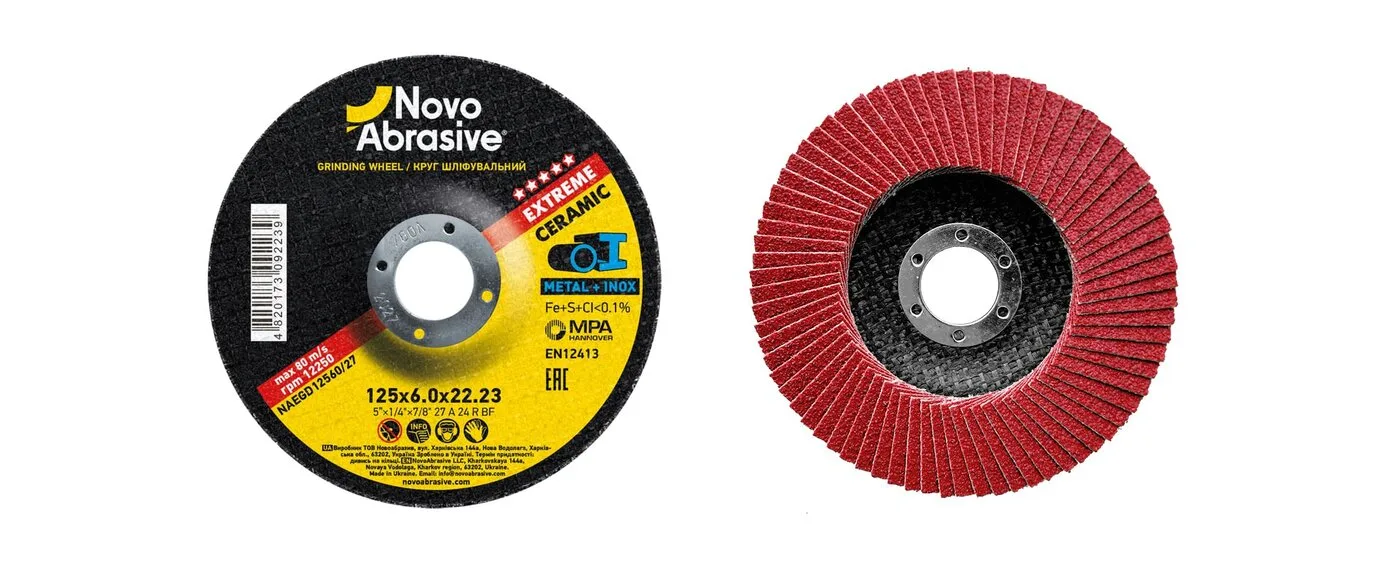
After welding a bead, spatter and scale remain on the part. They can be removed with two tools on an ordinary 125 mm grinder — and welders have argued for years which one is better. The answer is simple: they are not rivals but two stages of one job. Below is when to take which and how to combine them.
Two tools — two jobs
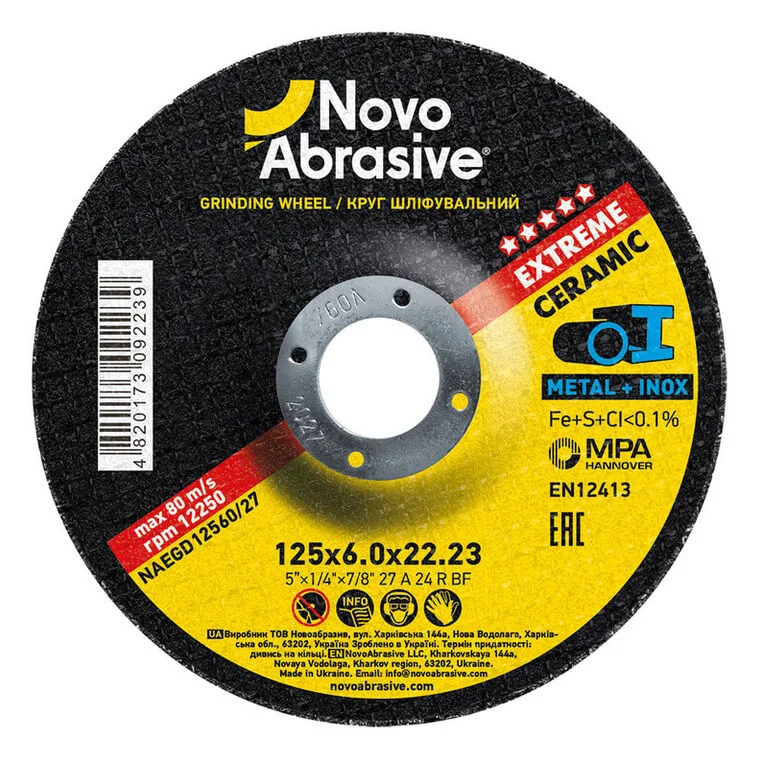
A grinding disc is a thick Type 27 disc, 6.0 or 8.0 mm, on a reinforced resin bond. It works with its side face at 15–30° and is made for one thing: removing metal as fast as possible. It levels a 3–4 mm butt-weld bead with the base metal in a few passes. The surface after it is rough, with visible scratches from the 24–30 grain.
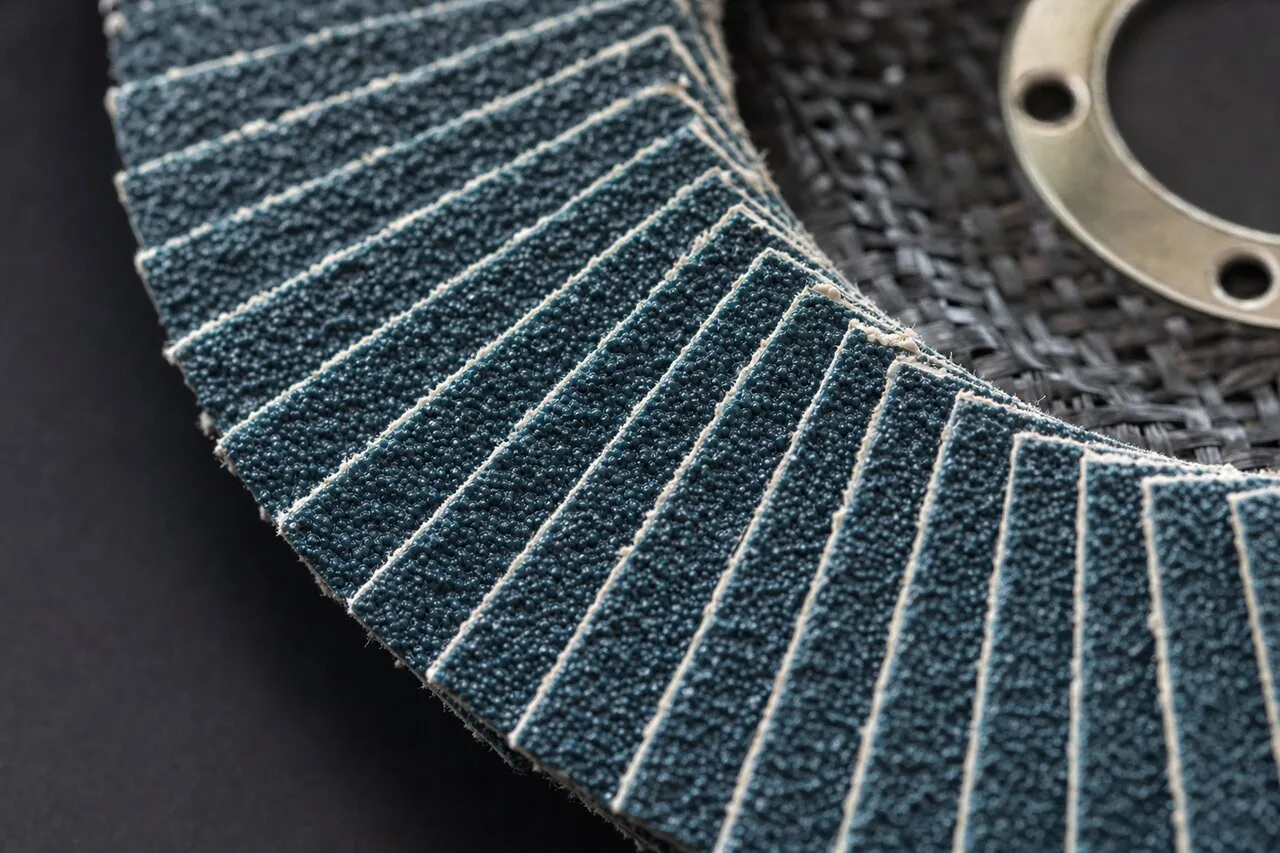
A flap disc is a backing plate with a fan of abrasive-cloth flaps on P36–P120 grain. It removes metal moderately but leaves an even, uniform surface, does not overheat thin metal and does not "dig" into the workpiece. The T27 (flat) shape works at 0–15°, T29 (conical) more aggressively, at 15–25°.
Hence the main rule: the grinding disc removes volume, the flap disc finishes the surface. The construction of each is explained in the guides "Grinding disc: what it is and how to choose" and "How to choose a flap disc".
Table: which disc for which seam
| Seam and metal | First tool | Second tool | Comment |
|---|---|---|---|
| Butt weld, steel from 3 mm, bead 2–4 mm | Grinding disc 6.0 mm | P60–P80 flap disc | The grinding disc leaves 0.5–1 mm above the surface, the flap disc levels it |
| Fillet weld, hard-to-reach spot | Grinding disc 115–125 mm or T29 P40 flap disc | P80 flap disc | The conical T29 gets into the corner at 15–25° |
| Thin sheet up to 2 mm, TIG or spot weld | P60–P80 flap disc | P120 flap disc | A grinding disc will burn through or warp the sheet |
| Stainless steel, visible seam | INOX P60 flap disc (zirconia or ceramic) | P120 flap disc | Only an iron-free tool, no overheating to blue spots |
| A seam for painting or powder coating | Grinding disc 6.0 mm (if there is a bead) | P80 → P120 flap disc | Primer needs an even scratch, not deep furrows |
| Aluminium, non-ferrous metals | P40–P60 flap disc | P80–P120 flap disc | Short passes, otherwise the grain glazes over |
When a grinding disc is a mistake
- Thin metal. A 6 mm disc concentrates heat on a small area: a 1.5–2 mm sheet turns blue, warps and burns through.
- A surface for painting. The 24–30 grain leaves furrows that show through even a thick primer layer; you will have to cover them with a flap disc anyway.
- Stainless steel "for looks". A grinding disc easily overheats the seam to temper colours, and an ordinary (non-INOX) disc also contaminates the surface with iron.
- A low bead. If the seam stands 1–1.5 mm proud, a P40 flap disc will remove it on its own, without an extra step.
When a flap disc is a mistake
- A high bead on thick metal. A flap disc takes many times longer than a grinding disc to remove a 3–4 mm bead and "eats" a disc every few metres of seam. That is slow and expensive.
- Scale and spatter after welding. Hard metal droplets wear flaps quickly; they are easier to knock off with a grinding disc or a brush.
- Chamfering for welding. This needs volume — a job for the grinding disc.
The order of seam work in practice
- Grinding. A 6.0 mm grinding disc at 15–30°, moving along the seam, no dwelling in one spot. Take the bead down to 0.5–1 mm above the base metal — not to zero, or you easily "sink" the seam.
- Levelling. A P60–P80 flap disc (T29 if you need it more aggressive, T27 for a flat surface) evens out the remaining bead and removes the scratches of the grinding disc.
- Finish. For primer and paint — a P120 flap disc; for polishing stainless steel — on to P180–P240 and non-woven material.
- Check. Run a ruler across the seam: there must be neither a hump nor a hollow. For critical structures the depth of removal is set by the technologist.
For stainless steel the whole chain is done with INOX-marked tools and with working pauses so the metal does not overheat. The step-by-step technique with photos is in the guide "Grinding weld seams".
NovoAbrasive discs for weld seams
| Tool | What is in the range (125 mm) | For which stage |
|---|---|---|
| Type 27 grinding discs | 125×6.0 mm in the Extreme (ceramic grain, Metal + Inox), Profi and Standard series; 125×8.0 mm — Profi; 12 200 rpm | Removing the bead, chamfers, scale |
| T27 / T29 flap discs | P36–P120; Standard — aluminium oxide, Profi — aluminium oxide or zirconia, Extreme ZR — zirconia alumina, Extreme CR — ceramic grain; 12 200 rpm | Levelling, finish, stainless steel |
Grinding discs are made to EN 12413, certified by MPA Hannover and pass the oSa side-load test on the factory's own test bench; flap discs are coated abrasives, their standard is EN 13743.
Frequently asked questions
Can a weld seam be removed with a flap disc alone?
Yes, if the bead is low (up to 1.5–2 mm) or the metal is thin. On a 3–4 mm bead on thick steel it takes much longer than a grinding disc and uses up several flap discs where one grinding disc would do.
Which flap disc grit for a weld seam?
P40–P60 — to remove the remaining bead and the scratches of the grinding disc, P80–P120 — for the finish under primer and paint. For stainless steel with a visible seam take a zirconia or ceramic INOX disc and finish with P120.
T27 or T29 for a weld seam?
T29 (conical) is more aggressive and works at 15–25° — it removes the remaining bead better and gets into corners. T27 (flat) works at a low angle and gives a flat surface for finishing.
Can a stainless-steel seam be ground with an ordinary disc?
No. A disc without the INOX mark contains iron, sulphur and chlorine, which stay in the surface and produce rust within weeks. Take INOX grinding and flap discs and do not overheat the seam to blue temper colours.
Is a grinding disc needed for a TIG seam on thin sheet?
No. A TIG seam is low and neat, and a grinding disc will overheat and warp a 1–2 mm sheet. A P80 flap disc is enough, then P120 for paint.
NovoAbrasive grinding and flap discs
Both tools for weld seam work from one factory: grinding discs — EN 12413, MPA Hannover, oSa test; flap discs — EN 13743. Wholesale prices from the manufacturer.
Go to the catalog