















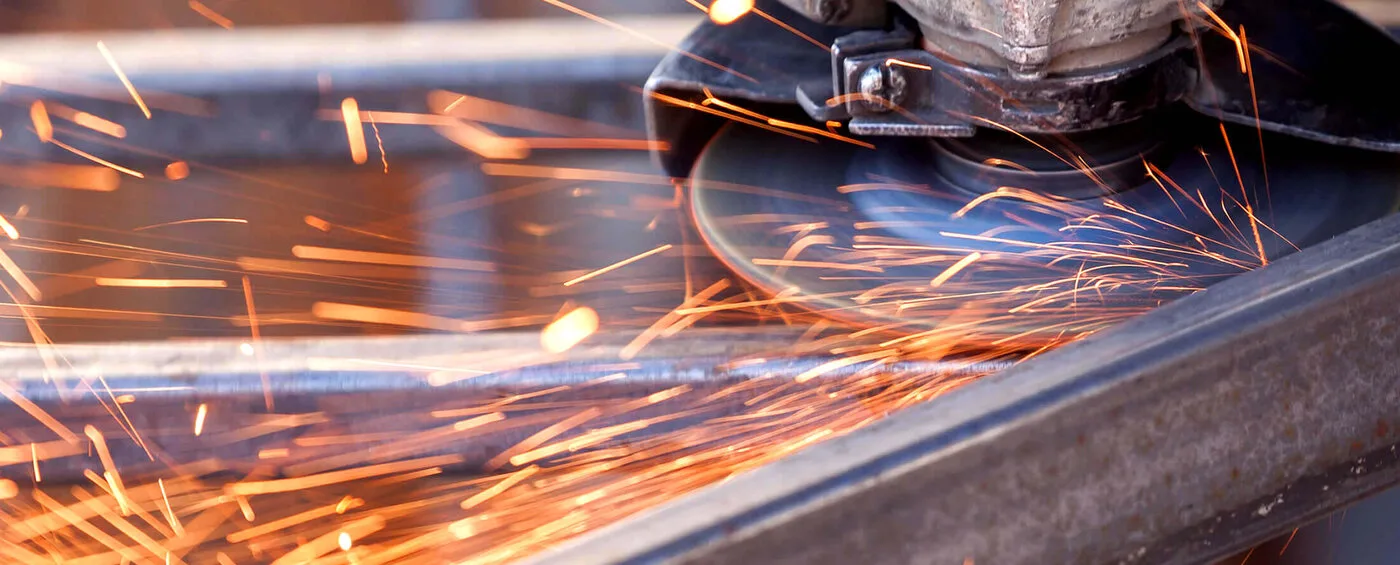
"Sanding disc", "grinding disc", "scraping disc" - in everyday life it is the same tool: a thick disc for removing metal with a grinder. The confusion begins when you try to cut with it - or, conversely, grind with a cut-off disc. We explain what a sanding disc is, how it differs from its neighbors and how to choose one.
What is a polishing disc?
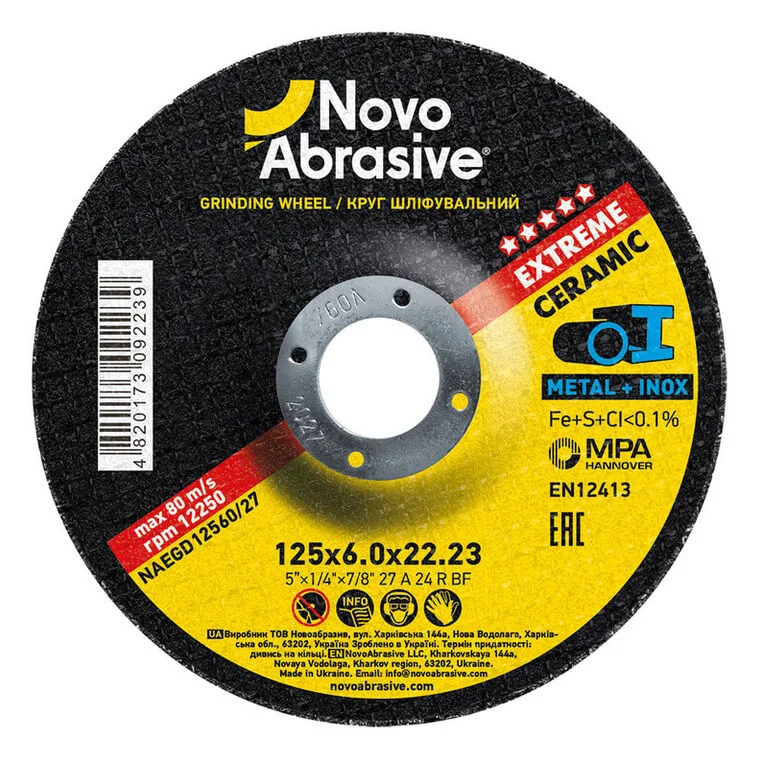
A grinding disc (also known as a grinding or metal-cutting disc) is an abrasive disc on a bakelite bond, reinforced with several layers of fibre mesh. It is distinguished from a cutting disc primarily by its thickness — 6.0 or 8.0 mm versus 0.8–3.2 mm — and the Type 27 shape: the recessed center allows you to work with the side surface without catching the mounting nut.
The main tasks of the polishing disc:
- removal of welds - alignment of the weld to the plane of the base metal;
- stripping - removal of scale, rust, foundry deposits;
- chamfering - preparation of edges for welding;
- rough surface leveling before finishing with a flap disc.
Grinding discs are manufactured to the same standard as cutting discs - EN 12413, with an operating speed of up to 80 m/s. NovoAbrasive discs are additionally certified by MPA Hannover (Germany).
Structure and marking
On the label of the grinding disc, in addition to the size, there is always an abrasive code. Let's analyze it using the example of the NovoAbrasive Extreme disc:
- Type 27— recessed center: the mount is “recessed”, you can place the wheel on the workpiece almost flat;
- grain 24–30— larger than that of cutting: priority is the speed of metal removal, not the cleanliness of the cut;
- fibre reinforcement - several layers across the entire plane, because the disc works on bending;
- INOX marking (Fe+S+Cl<0.1%) — free of iron and sulfur, safe for stainless steel.
Grinding vs cutting: what's the difference?
Outwardly, these are similar discs, which is why they are most often confused. The difference is fundamental:
| Parameter | Grinding disc | Cutting disc |
|---|---|---|
| Thickness | 6.0–8.0 mm | 0.8–3.2 mm |
| Shape | Type 27 (recessed center) | Type 41 (flat) / 42 |
| Work surface | Lateral plane | End (edge) |
| Angle to workpiece | 15–30° | 90° |
| Task | Metal removal, grinding | Cutting |
| Grain | Large (24–30) | Smaller (30–60) |
Strip vs flap vs fibre
There are three tools for grinding with a grinder. In short, when is which one:
| Tool | Removes metal | Surface after | When to choose |
|---|---|---|---|
| Grinding disc | As fast as possible | Rough | Welds, scale, large volumes |
| Flap Disc | Moderately | Smooth, clean | Finish, preparation for painting |
| Fiber disc | Quickly | Controlled | Point work, profile details |
Typical connection in practice: rough removal of the seam with a grinding disc → leveling with a flap disc P60–P80. A detailed analysis of all three types is in the guide "How to choose a grinding disc".
NovoAbrasive sizes and series
The NovoAbrasive range includes 37 models of grinding discs with diameters from 115 to 230 mm:
| Diameter | Thicknesses | Under what angle grinder | Typical application |
|---|---|---|---|
| 115 mm | 6.0 / 8.0 mm | Compact KShM | Small details, hard-to-reach places |
| 125 mm | 6.0 / 8.0 mm | The most common KShM | Universal stripping, seams |
| 150 mm | 6.0 mm | Average KShM | Balance of maneuverability and space |
| 180 mm | 6.0 / 8.0 mm | Powerful angle grinder from 1500 W | Large surfaces, structures |
| 230 mm | 6.0 / 8.0 mm | Powerful 2000 W angle grinder | Metal structures, large seams |
Thickness 8.0 mm provides maximum service life during intensive work; 6.0 mm is standard for most tasks. Series - by intensity of use:
- Extreme— ceramic grain, Metal + Inox: maximum metal removal in industrial conditions;
- Profi - daily professional work, uniform wear;
- Standard— household and infrequent grinding jobs.
How to work with a polishing disc
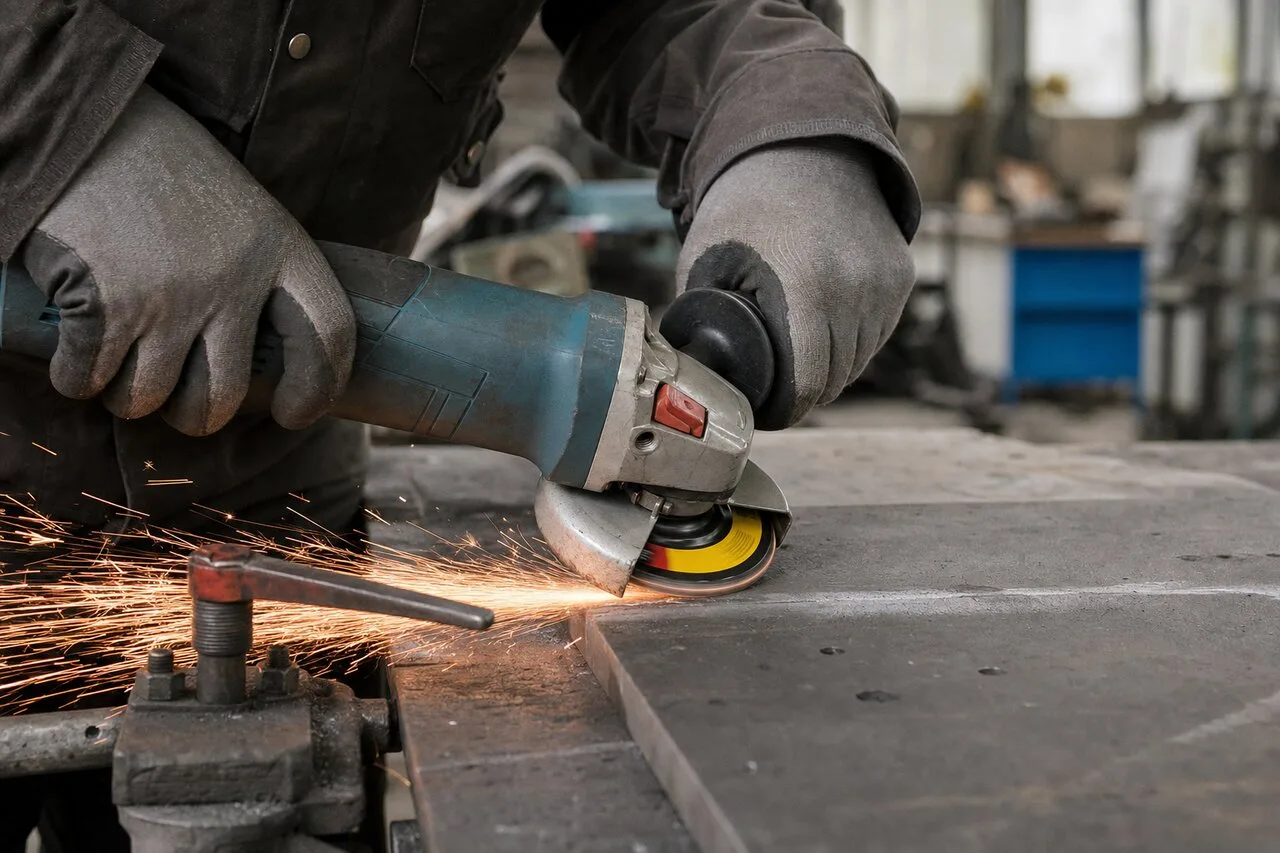
- Angle 15–30°— a smaller angle “blurs” the disc, a larger one leaves deep furrows;
- tool weight — sufficient pressure: do not press, let the grain work;
- movement - along the seam in smooth passes, without stopping in place;
- INOX for stainless steel: a regular wheel contaminates the surface with iron - corrosion will appear in a few weeks;
- Protection is mandatory: glasses or a shield, gloves, a cover on the KShM.
Step-by-step technique for removing a weld from a photo — in the guide "Grinding Welds".
Frequently asked questions
Are a polishing disc and a grinding disc the same thing?
Yes, for a grinder, these are synonyms: a thick Type 27 disc for removing metal with a plane is called both a polishing disc, a grinding disc, and a grinding disc. Do not confuse it with flap and fibre discs - these are separate tools for cleaner processing.
Can I cut with a grinding disc?
It's not worth it. A 6 mm wide cut requires five times more energy than a 1.2 mm cutting disc: the workpiece overheats, the grinder works with overload, and the cut is rough. Use a cutting disc for cutting.
Can I grind with the side of a cutting disc?
Absolutely not. The reinforcement of the cutting disc is designed only for loads in the cutting plane; lateral pressure can destroy the disc at an operating speed of 80 m/s. For grinding, there is a grinding disc - its design and shape Type 27 are created specifically for working in a plane.
What diameter of grinding disc should I choose?
The diameter is determined by your grinder: the most common is 125 mm. For large metal structures and long seams, use 180 or 230 mm on a powerful angle grinder (from 1500–2000 W). It is forbidden to use a disc with a larger diameter than that provided by the tool.
Which thickness is better — 6.0 or 8.0 mm?
6.0 mm is a universal standard: more maneuverable and cheaper. 8.0 mm contains more abrasive, so it lasts longer in daily intensive work - it is chosen by workshops and production facilities. For one-time work, there is practically no difference.
NovoAbrasive grinding discs
37 models 115–230 mm in three series. EN 12413, MPA Hannover certification, oSa test. Wholesale prices from the manufacturer.
Go to the catalog