















A saw blade for metal is not chosen “by diameter”. The tooth grind, the rake angle and the tip material decide whether the cut will be clean and how long the blade will last. We go through the geometry of two WellCut series — WSM for non-ferrous metals and the cermet WSS for steel— and what makes them fundamentally different from wood blades and abrasive cut-off wheels.
What cermet is
Cermet blades are saw blades whose tooth cutting elements are made of cermet, a ceramic-metal composite. The name itself comes from the English words CERamic + METal: hard ceramic particles are held in a metal binder. In hardness and heat resistance this material surpasses ordinary carbide, so it withstands cutting steel without any cutting fluid.
Three points worth stating right away:
- Cermet refers to the cutting part of the teeth, not the whole blade. The body remains steel.
- The teeth remove metal chips— the blade cuts with an edge, like a milling cutter, it does not abrade the metal.
- This is a fundamentally different tool from an ordinary abrasive cut-off wheel for an angle grinder.
In the WellCut range this group contains two items — WSS60305 and WSS80355, declared for steel and stainless steel. They are matched to specialised low-speed metal saws with the requirements of the specific machine in mind.
Tooth geometry: ATB, TCG and MTCG
The tooth grind is the main difference between blades for wood, for non-ferrous metals and for steel. Wood is cut with the ATB grind (alternating bevelled tips), metal with grinds of the Triple Chip Grind family, where the load is deliberately split between two tooth types.
WSM series — for aluminium and copper
- TCG grind (trapeze + flat tooth). Seen from the face the teeth alternate: one has its tip chamfered at 45°, the next is strictly rectangular. By comparison, wood blades use the ATB grind.
- The rake angle is negative, about −5°: the tip is tilted back relative to the blade radius. The tooth does not bite in but smoothly scrapes the metal — the workpiece is not pulled in, even on a thin-walled profile.
- The gullet between the teeth is shallow and compact. Non-ferrous chips are fine, and a smaller cut-out in the body makes the blade considerably stiffer and prevents side vibration under the resistance of metal.
- The tip carbide is a special grade: a different grain size and an increased cobalt binder. The alloy is more ductile at the micro level, which resists edge chipping and the build-up of molten aluminium.

WSS series — for steel and stainless steel
- MTCG grind (Modified Triple Chip Grind). The trapezoidal tooth with 45° side chamfers removes the central third of the chip, the next rectangular flat tooth cleans the side corners of the groove. The scheme spreads the very high resistance of cutting steel across different parts of the edge, eliminating the concentration of destructive stress on the sharp corners of the tip.
- The rake angle is neutral or close to zero (0…−2°). The tips stand almost vertically relative to the blade radius: a zero angle keeps the blade from aggressively pulling the steel workpiece under itself, giving a predictable, smooth high-force cut with minimal sparking.
- A compact U-shaped gullet— a shallow semicircular pocket. The chip flies out freely while the blade body keeps the maximum area of solid metal, which gives radial stiffness under high torque.
- Brazing with a three-layer silver filler (silver — copper — silver), and the seat geometry supports the tip not only from below but also from behind, with a massive steel back.
In international terminology this tooth shape is called the Chip Limiter tooth profile, or anti-kickback design— a tooth with a feed limiter.

The chip limiter and why cermet does not chip
The chip limiter (Chip Limiter, damping stop) — a projection on the steel body of the blade immediately behind the cutting tip, made fractions of a millimetre below the cutting edge. Metal-ceramic is extremely hard and heat-resistant but far more brittle than classic tungsten-carbide-based alloy. When cutting steel on installation pivot saws the operator can easily push the handle sharply; the projection physically prevents the tooth from digging into the steel deeper than the design chip thickness — about 0.05–0.1 mm per pass of a single tooth— and takes the excess pressure itself.
Cermet blade versus abrasive wheel
The fundamental difference lies in the cutting mechanism. An abrasive abrades the metal and heats it strongly: the edge darkens, becomes covered with scale, and the metal along the cut line may lose its original properties. A cermet blade shears the metal with an edge, and the heat leaves with the chip.
| Parameter | Abrasive cut-off wheel | Cermet saw blade |
|---|---|---|
| Cutting mechanism | abrasion by abrasive grain | chip removal by a cutting edge |
| Heating the workpiece | strong | minimal, the workpiece stays cold |
| Edge condition | scale, temper colours | clean, ready for welding without deburring |
| Sparking | intense | minimal |
| Tool size | the diameter shrinks as it wears | the diameter stays constant — the cut size does not drift |
| Equipment | Angle grinders, cut-off machines, power cutters | metal dry cut saws |
How many teeth you need
Tooth count is chosen for the job, not by “the more the better”: more teeth — a cleaner cut, fewer teeth — a thicker chip and a faster pass.
- 60–72 teeth— work faster, suited to thick-walled profiles, tubes and copper busbars.
- 80 teeth— the universal choice for everyday work.
- 96 teeth— the cleanest possible cut; needed where the edge stays visible in the finished part.
The range: eight items
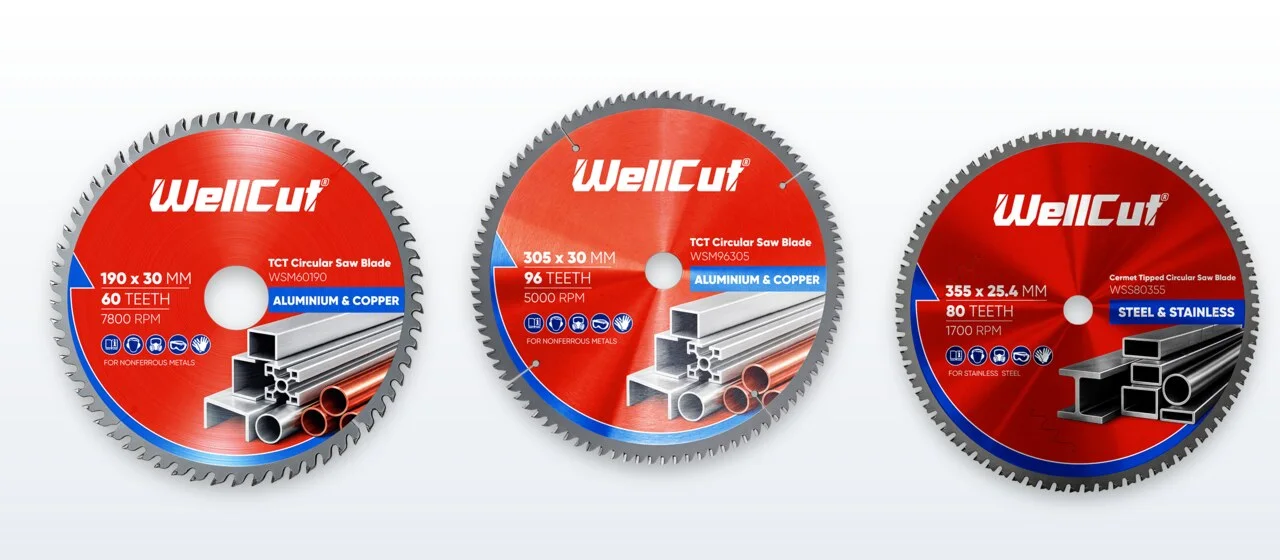
The WSM series — six sizes from 190 to 305 mm with a 30 mm bore. The WSS series — two sizes, 305 and 355 mm, with a 25.4 mm (1") bore, the most common standard for metal-cutting equipment of this class.
WellCut WSM — aluminum, copper, non-ferrous metals
| Item | D × D, mm | Teeth | Max. rpm | Equipment |
|---|---|---|---|---|
| WSM60190 | 190 × 30 | 60 | 7800 | Hand-held circular saws, compact mitre saws |
| WSM72210 | 210 × 30 | 72 | 7000 | Mitre saws, bench machines |
| WSM80216 | 216 × 30 | 80 | 7000 | Mitre and combination saws |
| WSM80250 | 250 × 30 | 80 | 6000 | Machines for aluminium and PVC profiles |
| WSM96255 | 255 × 30 | 96 | 6000 | Sliding saws, profile mitre saws |
| WSM96305 | 305 × 30 | 96 | 5000 | Machines for façade and window profiles |
WellCut WSS — cermet, steel and stainless steel
| Item | D × D, mm | Teeth | Max. rpm | Equipment |
|---|---|---|---|---|
| WSS60305 | 305 × 25,4 | 60 | 2000 | Dry cut saws 12" |
| WSS80355 | 355 × 25,4 | 80 | 1700 | Dry cut saws 14" |
The item code logic: WSM/WSS— the product group, the first two digits — the tooth count, the rest — the outer diameter. For example, WSM96305 is WSM, 96 teeth, 305 mm.
Equipment and security
A blade is chosen not only by the bore but also by the machine speed: the equipment speed must not exceed the maximum for the blade. For WSM that is 5000–7800 rpm depending on the diameter, for the cermet WSS 1700–2000 rpm, that is slow, high-force cutting.
- Mount saw blades on an angle grinder or a power cutter.
- Cut carbon and stainless steels, cast iron and abrasive materials with an aluminium blade — or, conversely, aluminium, non-ferrous metals or wood with a cermet blade.
- Work without clamping the workpiece firmly: cermet is hard but sensitive to vibration and side loads.
- Exceed the maximum rotation speed marked on the blade.
Cooling: not mandatory for the WSM series; for production work a lubricant or cutting fluid for aluminium is recommended. The cermet WSS series runs dry— no cutting fluid is applied.
Frequently asked questions
Can steel be cut with an aluminium blade?
No. WSM blades have a negative rake angle and a carbide grade chosen for soft non-ferrous metals. On steel such a tooth overheats and chips. For steel and stainless steel, the cermet blades of the WSS series are intended.
What is cermet and why is it better than carbide?
Cermet is a ceramic-metal composite (CERamic + METal): hard ceramic particles in a metal binder. It is harder and more heat-resistant than carbide, so it cuts steel without cutting fluid. Only the cutting elements of the teeth are cermet — the blade body is steel.
Why does the tooth need a chip limiter?
Cermet is more brittle than carbide, and a sharp push on the handle of a pivot saw can chip a tooth. The limiter — a projection on the blade body behind the tip, fractions of a millimetre below the edge — physically prevents the tooth from digging deeper than the design chip thickness (0.05–0.1 mm per pass) and takes the excess pressure itself.
Can a cermet blade be mounted on an angle grinder?
No. WSS blades are rated for 1700–2000 rpm and firm clamping of the workpiece on a dry cut saw. An angle grinder runs several times faster and its design does not provide the required rigidity — that is dangerous.
Is cutting fluid required?
For the cermet WSS series no — cutting is dry and the heat leaves with the chip. For WSM cooling is not mandatory, but for production work on aluminium a lubricant or cutting fluid is recommended.
How many teeth should I choose?
60–72 teeth — a faster pass on thick-walled profiles, tubes and copper busbars. 80 teeth — the universal choice. 96 teeth — the cleanest edge, when the cut stays visible in the finished part.
WellCut saw blades for metal
Carbide blades for aluminium and non-ferrous metals and cermet blades for steel — from 190 to 355 mm.