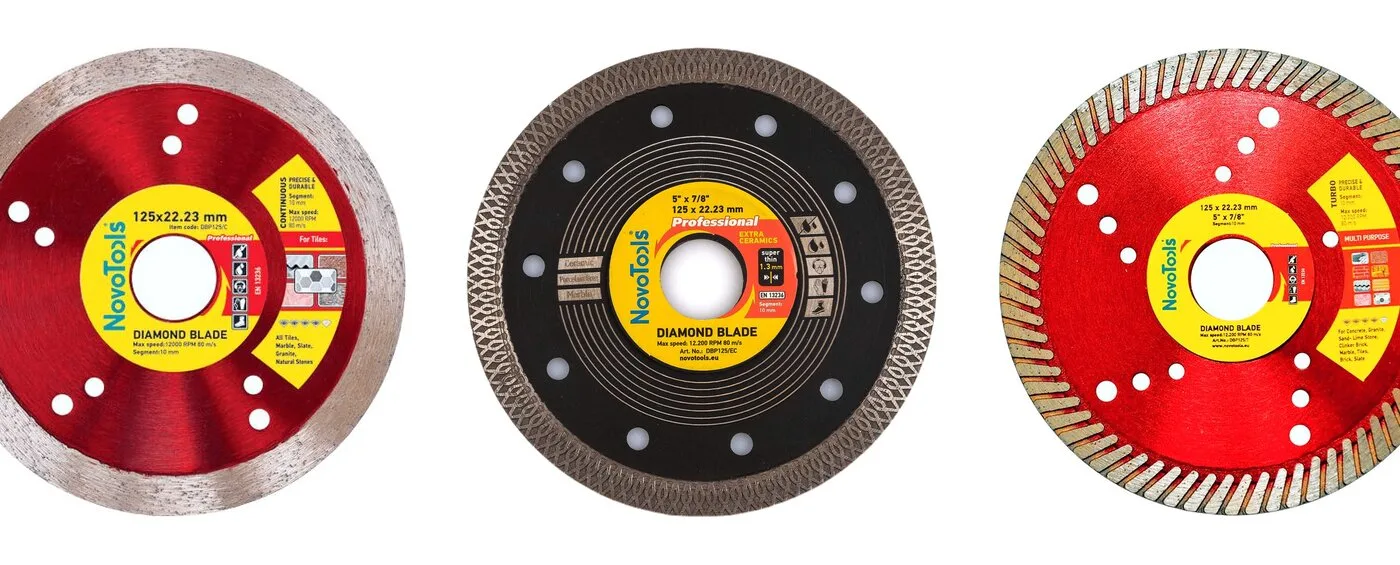
Diamond discs of 125 mm look alike but cut differently: one gives a perfect edge on glaze, another saws concrete but chips tile. The difference is the shape of the diamond rim. We explain which disc to take for ceramic and porcelain tile, and which to leave for concrete and stone.
Three types of diamond rim
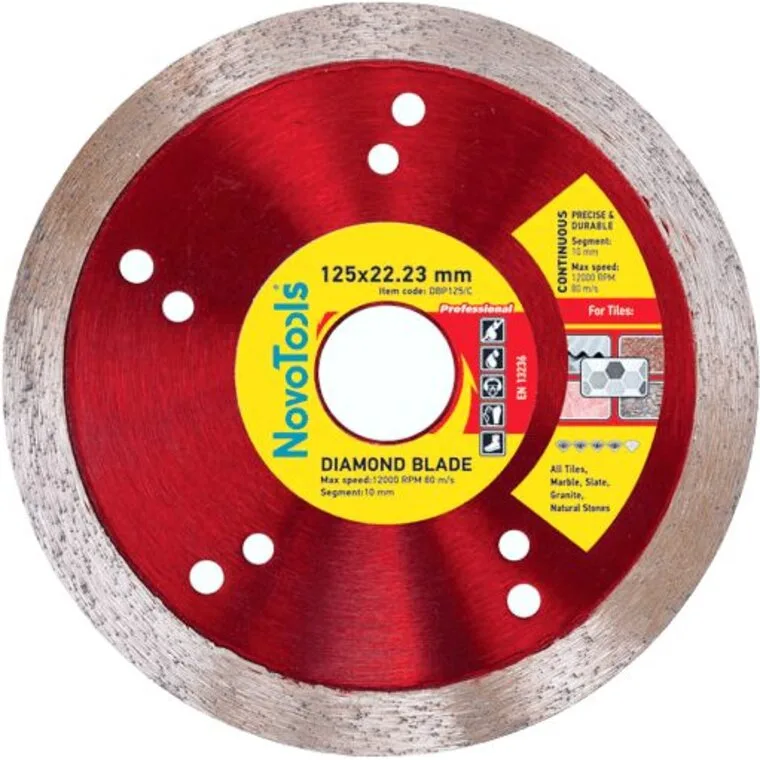
Continuous (uninterrupted) rim. The diamond layer runs around the entire circumference without gaps. The edge touches the material continuously, so it does not hammer the glaze or chip it away. The price of a clean cut is slower cutting. The disc is universal: it works both dry and with water, and with water it cuts cleaner and lasts longer. Among NovoTools discs, these are the "Tile" models — in the Standard and Profi series (5 mm layer, 1.8 mm rim) and Extreme (7 mm layer, 1.6 mm rim), all for wet or dry cutting — and "Extra Ceramics" (Extreme): an ultra-thin continuous-rim disc for dry cutting with a 0.8 mm body and a 1.3 mm rim for porcelain stoneware, granite and marble.
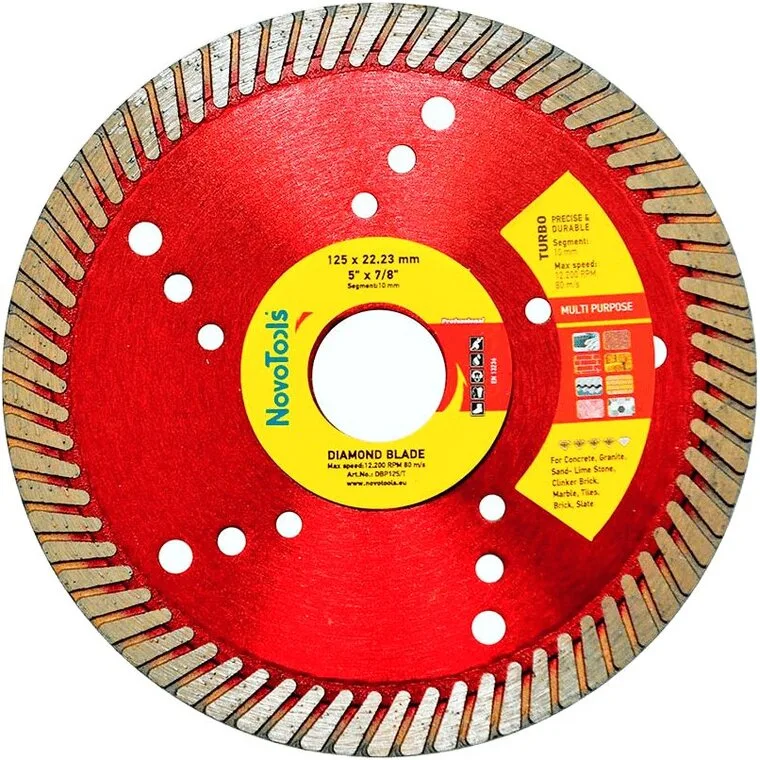
Turbo. The rim is also continuous, but with slanted grooves and a wavy edge: the grooves carry away dust and air, so the disc cuts faster and heats up less when dry. The downside is intermittent contact, which leaves small chips on glazed tiles. All NovoTools 125 mm turbo discs are for dry cutting: the "Turbo" Extreme has a 2.2 mm rim, the Profi 2.4 mm, the "Turbo Wave" Standard 2.6 mm; applications: concrete, reinforced concrete, brick, stone, granite.
Segmented. The rim is divided into segments with wide slots. The best cooling and the fastest cutting of concrete and brick: wet or dry in the Standard and Profi series, dry in Extreme, plus the "Deep Cut" version for deeper cuts. Not used for tiles: each segment strikes the edge and the glaze chips off.
Comparison table: continuous, turbo, segmented
| Parameter | Continuous ("Tile", "Extra Ceramics") | Turbo | Segmental |
|---|---|---|---|
| Material | Ceramic tile, porcelain tile, glass, marble, granite | Concrete, reinforced concrete, brick, stone, granite | Concrete, brick, stone, rough tile cutting |
| Cut edge on glaze | Clean, no chips | Micro-chips | Chips |
| Cutting speed | Slow | Ambulance | Fastest |
| Dry cooling | Poor | Good | Best |
| Wet / dry cutting | "Tile" — both (all series); "Extra Ceramics" — dry | Dry | Standard, Profi — both; Extreme — dry |
| NovoTools 125 mm edge thickness | 1.3–1.8 mm | 2.2–2.6 mm | 1.8–2.0 mm |
| Max. rpm, 125 mm | 12 200 rpm (80 m/s), bore 22.23 mm, EN 13236 | ||
Porcelain tile: why a thin continuous disc is needed
Porcelain tile is denser and harder than ordinary ceramic tile, so an ordinary "Tile" disc cuts it slowly and heats up. For it there are ultra-thin continuous discs like "Extra Ceramics": a 0.8 mm body and a 1.3 mm edge remove 20–30 % less material than "Tile" with a 1.6–1.8 mm edge, the cut goes easier, there is less heat and almost no chipping of the glaze.
- No pressure. A thin body is easy to bend — the disc must cut under the tool's own weight.
- Slow feed. Especially entering and leaving the material: these are the spots where chipping happens most.
- Dry cutting — in short passes."Extra Ceramics" is designed for dry cutting: let the disc cool down at idle. For wet cutting of porcelain stoneware on a tile saw, use the universal "Tile" Extreme.
Wet or dry cutting
Water cools the diamond layer, flushes out slurry and binds dust, so with water a continuous-rim disc lasts longer and cuts cleaner. On an electric tile saw this is the standard mode; "Tile" discs of all series work both wet and dry. An angle grinder must not be used with water: it cuts dry, with discs rated for dry or universal use ("Extra Ceramics", "Tile", turbo, segmented) and according to these rules:
- cut in short passes, letting the disc cool at no load;
- do not keep the disc in the cut for more than 30–40 seconds at a time on porcelain tile;
- take a disc marked "universal (wet/dry)" if the modes alternate; do not use a "wet only" disc dry.
How to cut tiles with an angle grinder without chips
- Marking and tape. Tape the cutting line with masking tape and mark on top of it: the tape holds the glaze at the edge.
- Support. Lay the tile on a flat rigid base so that the cut-off part does not break away under its own weight at the end of the cut.
- First pass — a score. Run the disc along the line 2–3 mm deep: it is the glaze that chips, and a shallow score "seals" it.
- Through cut. Cut through on the second pass without tilting the disc or changing direction — misalignment breaks a thin disc.
- Exiting the cut. Reduce the feed at the end: breaking out the last centimetre is the main cause of chipping on the edge.
Mandatory: safety goggles, a respirator (ceramic dust contains quartz) and the guard on the grinder. The general rules are in the angle grinder safety guide.
NovoTools discs 125 mm
The 125×22.23 mm diamond disc range has 14 models: NovoTools in the Standard, Profi and Extreme series plus WellCut discs:
- "Tile" (continuous rim) — in every series (Standard, Profi, Extreme) and WellCut — wet or dry cutting; for ceramic tiles, marble, glass;
- "Extra Ceramics" (Extreme, ultra-thin continuous rim, dry cutting) — for porcelain stoneware, granite, marble;
- "Turbo" and "Turbo Wave" (dry cutting) — for concrete, brick, stone, granite;
- "Segment" and "Deep Cut"— for concrete, reinforced concrete and rough cutting.
All discs comply with EN 13236 and have a maximum speed of 80 m/s (12 200 rpm for 125 mm); some models are also made in 230 mm for more powerful grinders.
Frequently asked questions
Can tiles be cut with a turbo disc?
Yes, for rough cuts that will hide under a skirting or in a corner: turbo cuts fast and does not heat up. On a visible edge the glaze will have micro-chips — for face cuts take a continuous-rim disc.
Which disc to cut 125 mm porcelain tile with?
With an ultra-thin continuous-rim disc such as "Extra Ceramics" (0.8 mm body, 1.3 mm rim): dry, without pressure, with a slow feed and cooling pauses. For wet cutting on a tile saw, use the universal "Tile" Extreme.
Why is a segmented disc unsuitable for tiles?
Every segment hits the cut edge separately and the glaze crumbles. The segmented disc is made for concrete and brick, where speed and cooling matter more than a clean edge.
Can concrete be cut with a continuous-rim disc?
Yes, but slowly and with overheating, because a continuous rim removes heat and dust poorly. For concrete, brick and stone take a turbo or segmented disc.
The disc stopped cutting — is it worn out?
Not necessarily. On hard porcelain tile the diamond layer "glazes over": the edge shines, the cut slows down, a smell appears. Make a few cuts in an abrasive material — brick or sandstone — to expose fresh diamonds.
NovoTools diamond discs 125 mm
Continuous-rim, turbo and segmented discs in the Standard, Profi and Extreme series. EN 13236, 80 m/s. Wholesale prices from the manufacturer.
All 125 mm diamond blades