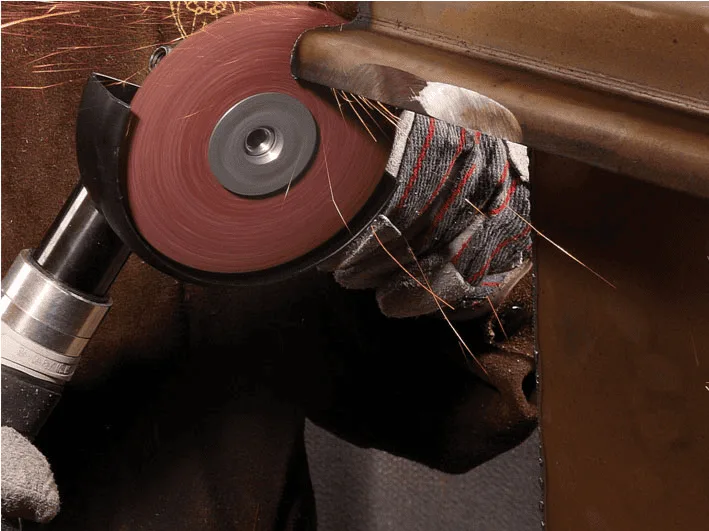
What is a fiber disc and how does it work?
A fibre disc (fibre disc, fiber disc) is a flexible grinding disc that is mounted on an angle grinder (grinder) via a backing pad. Unlike flap or grinding discs, a fibre disc has a thin but rigid base of vulcanised fibre, which provides aggressive metal removal with controlled surface quality.
The design consists of three components:
- Abrasive layer - grains of corundum, zirconium or ceramic, fixed to the base with a resin bond. The type of grain determines the productivity, resource and cost of processing.
- The fibrous base is a dense vulcanized fiber (cellulose impregnated with resin) with a thickness of 0.8–1.0 mm. It provides rigidity, heat resistance and flexibility at the same time. It is from this base that the name “fibrous” comes.
- 22.23 mm center hole is a standard fit for mounting on a M14 threaded backing pad. The fiber wheel does NOT mount directly to the spindle - a backing pad is required.
Working principle: the fiber wheel is mounted on the backing plate and pressed by the flange of the grinder. When rotating (11,000–13,300 rpm depending on the diameter), the abrasive grain cuts micro chips from the surface of the workpiece. As the grain wears, it chips, exposing new sharp edges - this is the principle of self-sharpening, which ensures stable performance throughout the entire service life of the disk.
Fiber vs flap vs strip
Three types of grinding wheels for angle grinders solve different tasks. A detailed comparison will help you choose the right tool:
| Parameter | Fiber disc | Flap Disc | Grinding Wheel |
|---|---|---|---|
| Thickness | 0.8–1.0 mm (+ plate) | 6–8 mm | 4–8 mm |
| Needs a plate | Yes (required) | No | No |
| Aggressiveness of removal | ★★★★★ | ★★★☆☆ | ★★★★☆ |
| Surface quality | ★★★★☆ | ★★★★★ | ★★☆☆☆ |
| Vibration | ★★★☆☆ | ★★★★★ | ★★☆☆☆ |
| Resource | ★★★★☆ | ★★★☆☆ | ★★★☆☆ |
| Price per unit | Lowest | Medium | Higher |
| Grinding cost | Lowest per m² | Medium | High |
| Processing control | ★★★★★ | ★★★★☆ | ★★☆☆☆ |
| Stainless steel | ✔ (zirconium/ceramic) | ✔ (zircon) | ⚠️ overheating |
When to choose a fiber wheel:
- Aggressive metal removal with controlled surface quality is required
- Processing large areas - the lowest cost per m²
- Working with stainless steel (zirconium or ceramic)
- Removing paint, rust, scale from large surfaces
- Quick grit change – disc changes in 5–10 seconds
When to choose a flap disc:
- The best surface quality is required - preparation for painting, priming
- Finishing of welds - smoothing, leveling
- Working in hard-to-reach places - corners, internal seams
- Don't want to buy a backing plate separately
When to choose a polishing wheel:
- Maximum rough metal removal - large allowances, casting
- You need to remove the maximum in the minimum time, the surface quality is not important
- Cleaning after gas cutting, removing sprues
Step 1 — Choose the type of abrasive grain
The type of abrasive grain is the most important parameter of a fiber wheel. It determines the performance, resource and cost of processing one square meter of surface.
Corundum (AO) — aluminum oxide
A classic all-purpose abrasive with the lowest price per disc. Aluminum oxide (Al₂O₃) grains work well on carbon structural steel, cast iron and wood.
- The lowest price per disk — optimal for home use
- Works well on carbon steel, cast iron, wood
- Wide grit range P24–P120
- NOT recommended for stainless steel - may cause contamination and corrosion
Choose corundum if: you work infrequently, only with carbon steel or wood, your budget is limited.
Zircon (ZA) — zirconium corundum
Professional abrasive with self-sharpening properties. During operation, the zirconium grain chips, exposing new sharp edges. This ensures stable performance throughout the entire service life and increases the resource by 2–3 times compared to corundum.
- Self-sharpening - consistent performance from the first to the last meter
- Lifespan 2–3 times longer than corundum
- Less heating of the workpiece - cooler work
- Suitable for stainless steel (Fe and S-free series)
- Lowest treatment cost per m² with regular use
Choose Zircon if: you work every day, you need maximum performance, you work with stainless steel.
Ceramic grain (SG)
The most technologically advanced premium abrasive. The microcrystalline grain structure provides controlled micro-fracturing — each grain breaks down into dozens of small, sharp particles that maintain maximum cutting ability. The resource is 3–5 times longer than corundum.
- Maximum metal removal rate among all grain types
- Lifespan 3–5 times longer than corundum
- Minimal workpiece heating is critical for stainless steel and thin metal
- Micro-fracturing instead of blunting
Choose ceramics if: industrial grinding volumes, working with expensive materials (stainless steel, titanium), maximum performance is more important than the price of the disc.
Comparison of three types of grain
| Parameter | Corundum (AO) | Zircon (ZA) | Ceramics (SG) |
|---|---|---|---|
| Productivity | ★★★☆☆ | ★★★★☆ | ★★★★★ |
| Resource | ★★☆☆☆ | ★★★★☆ | ★★★★★ |
| Price per disc | ★★★★★ | ★★★☆☆ | ★★☆☆☆ |
| Cost of finishing 1 m² | Medium | Lowest | Low (large volumes) |
| Stainless steel | ❌ | ✔ | ✔ |
| Carbon steel | ✔ | ✔ | ✔ |
| Non-ferrous metals | ✔ | ⚠️ redundant | ❌ unjustified |
| Self-sharpening | No | Yes (chipping) | Yes (microchipping) |
Step 2 — Determine the grain size
The grit size of a fiber wheel determines the roughness of the finish, the metal removal rate, and the surface quality. The lower the number, the coarser the grain and the more aggressive the removal:
| Grit / Grain Size | Appointment | Roughness Ra, μm | Typical application |
|---|---|---|---|
| P24 | Rough peeling | 6.3–12.5 | Rust removal on large areas, rough allowances |
| P36 | Aggressive grinding | 3.2–6.3 | Weld seams, scale after hot rolling |
| P40 | Rough grinding | 2.5–3.2 | Welds, paint removal, cleaning |
| P60 | Medium grinding | 1.6–2.5 | Surface leveling, edge preparation |
| P80 | Semi-finished | 0.8–1.6 | Preparation for painting, leveling |
| P100 | Cleanliness | 0.4–0.8 | Preparation for priming |
| P120 | Finishing | 0.2–0.4 | Preparation for coating, decorative finishing |
Step 3 — Select the backing plate
A fiber disc cannot be mounted on a grinder without a backing pad. The backing pad performs three functions: it supports the disc, distributes pressure across the entire contact surface, and provides cooling through air channels. The type of backing pad determines the cutting result.
Rigid (hard) support plate
Hard plastic or rubber backing with minimal deflection. Provides maximum pressure per unit area and the most aggressive metal removal. Best choice for flat surfaces, weld removal and roughing. Provides a perfectly flat sanding surface.
Semi-rigid (medium) backing plate
A base with moderate flexibility - adapts to small surface irregularities while maintaining stable pressure. This is the most popular type among professionals - suitable for both flat surfaces and moderately curved parts.
Soft (flexible) backing plate
Flexible base that follows the contour of the workpiece. Ideal for processing pipes, bent parts, profiles and welded joints with complex geometry. Less pressure per unit area - softer processing, less risk of "burning through" on thin metal.
Diameter matching
| Diameter of the fibro disc | Diameter of the support plate | Carving |
|---|---|---|
| 115 mm | 115 mm | M14 |
| 125 mm | 125 mm | M14 |
| 180 mm | 180 mm | M14 |
For what work to use
Fiber wheels are a versatile grinding tool, but there is an optimal combination of grain and grit for each material.
Metalworking
- Welds— P36–P60, Zirconia (ZA). Aggressive weld removal with controlled quality. Sequence: P36 (remove weld) → P60 (align).
- Scale after rolling— P24–P36, zircon or corundum. Coarse grain quickly removes a thick layer of scale.
- Edges and chamfers— P60–P80, zircon. Edge preparation for welding, deburring after cutting.
- Paint and coating removal— P36–P60, corundum (AO). Corundum is sufficient for soft coatings, a cheaper option.
Stainless steel
Zirconia (ZA) or Ceramic (SG) ONLY - Corundum wheels may contain iron and sulfur impurities that cause contamination and corrosion of stainless steel.
- Welds on INOX— P60–P80, zircon. Start with P60, not P36 — aggressive grit overheats thin stainless steel and breaks the passive layer.
- Finishing: P80–P120, zirconia or ceramic. Sand in one direction to create a uniform satin texture.
- Runs (thermal oxidation colors)— P60, zircon. Uniform movements without stopping in one place.
Non-ferrous metals
- Aluminum— P60–P80, corundum with anti-clog coating. Reduced speed (50–70% of maximum). Conventional wheels quickly clog with soft aluminum.
- Copper and brass - P80–P120, corundum. Minimum pressure, slow, even movements.
Wood
- Surface grinding - P60–P80, corundum (AO). Work at low speed (6000–8000 rpm), evenly along the grain.
- Varnish and paint removal— P36–P60, corundum. Coarse grain removes old coatings more effectively.
Work technique
Proper technique doubles the life of your fiber wheel and ensures better quality of finish. Follow these five key rules:
Bevel angle: 15–30°. Hold the grinder at an angle of 15–30° to the surface. At a lower angle (<10°), the disc slips - low productivity and rapid grain clogging. At a higher angle (>35°), only the edge of the disc works - uneven wear, wavy marks and overheating. The optimal range for most tasks is 20–25°.
Pressure: Moderate. Press moderately — the weight of the tool plus a little extra pressure. Excessive pressure overloads the grinder's motor, overheats the workpiece (especially stainless steel) and reduces the life of the disc. With the right pressure, sparks fly evenly and do not change color to dark red.
Direction: away from you or left to right. Move the grinder evenly away from you or left to right. Do not linger in one place - this causes local overheating and blue runoff on the metal. On large surfaces, work in parallel passes with an overlap of 30–50%.
Speed: 11,000–12,200 rpm for 125 mm. Use full speed on the grinder for carbon steel. For stainless steel, reduce speed to 9,000–10,000 rpm if the grinder has a speed control. Too low a speed reduces efficiency and increases grain clogging.
Cooling: pause every 20–30 seconds. The fiber wheel dissipates heat through the air channels in the backing plate, but this is not enough for intensive work. Pause every 20–30 seconds to avoid overheating the workpiece and deforming the fiber base.
Common mistakes
- Working without a backing pad. This is DANGEROUS. The fiber wheel is thin and flexible - without a backing pad it has no rigidity, vibrates and can break at 12,000 rpm. A backing pad is always required, without exception.
- Incorrect size of the disc. 115 mm disc for 125 mm wheel - uneven wear, vibration, bending of the edges. 125 mm disc for 115 mm wheel - the disc protrudes beyond the edge of the disc and may contact the workpiece. The diameters must match.
- Grit too coarse for stainless steel. Do not start with P24 or P36 on stainless steel. Coarse grit will overheat the metal, disrupt the passive layer and cause pitting. Start with P60 minimum.
- Working with the “end” (90°). At an angle of 90°, only the edge of the disc is working. This leads to rapid wear, a wavy surface and overheating. Keep the angle between 15 and 30°.
- Storage in a humid place. The fiber base is hygroscopic. At humidity above 65%, the disc deforms, loses its flatness and may break during operation. Store horizontally, in the original packaging, in a dry room.
- Using a worn wheel. When the abrasive grain is completely worn away, only the fiber backing remains, which heats the surface and can leave burns. Replace the wheel when the grain has worn down to the backing.
- Corundum on stainless steel. Corundum wheels may contain impurities of iron and sulfur, which when heated are transferred to the surface of stainless steel and cause corrosion. For INOX - only zirconium or ceramic.
NovoAbrasive fiber wheels
NovoAbrasive produces fiber grinding wheels in two series - professional (zircon ZA) and economical (corundum AO). All products are certified according to the EN 13743 standard and are made from European raw materials.
A backing pad is required for proper operation of fiber discs. NovoAbrasive offers M14 hard and semi-hard discs in diameters of 115, 125 and 180 mm. The full range is available in the Accessories section.
| Parameter | Value |
|---|---|
| Diameters | 115, 125, 180 mm |
| Bore | 22.23 mm |
| Thickness | 0.8–1.0 mm |
| Grain type | Zirconium corundum (ZA), Aluminum oxide (AO) |
| Grit / Grain Size | P24, P36, P40, P60, P80, P100, P120 |
| Standard | EN 13743 |
| Support plate | M14, hard/semi-hard/soft (sold separately) |
Frequently asked questions
How does a fiber disc differ from a flap disc?
A fiber wheel is a thin disc (0.8–1.0 mm) with abrasive grain on a vulcanized fiber backing, which requires a backing pad. A flap disc is a self-supporting disc made of overlapping pieces of abrasive paper on a fiberglass backing. The fiber wheel removes metal faster and has a lower cost per m², while the flap disc gives a better surface quality and does not require a backing pad.
Is a backing plate mandatory?
Yes, it is mandatory! The fiber wheel is thin and flexible - without a backing plate it has no rigidity for work, vibrates and can break during rotation. The plate with an M14 thread is screwed onto the grinder spindle, and the fiber wheel is pressed with a flange from above. Never work without a plate.
Zircon or corundum?
Zirconium is more expensive per unit (by 30–50%), but the resource is 2–3 times longer. For daily work, zirconium is more profitable: the cost of processing one square meter is lower. For stainless steel - only zirconium. Corundum - for household use and infrequent work on carbon steel or wood.
What grit should I choose for a weld?
For rough removal of the weld seam, start with P36. After removing the main allowance, move on to P60 for leveling. If preparation for painting is required, finish with P80. The sequence P36 → P60 → P80 gives the best result. If the seam is not high, you can start with P60.
Is it possible to use stainless steel?
Zirconia or ceramic only. Corundum wheels can contain iron and sulfur impurities, which when heated transfer to the stainless steel surface and cause corrosion. Choose wheels marked INOX or with zirconia/ceramic grit. Start with P60 at least - too coarse a grit will overheat the stainless steel.
How to store fiber discs?
Store in a dry place with a humidity of up to 65%, horizontally, in the original packaging. The fiber base is hygroscopic - with increased humidity, the disc deforms, loses its flatness and may tear during operation. Do not leave the discs on the floor, near windows or in unheated rooms.
At what angle should I work?
The optimal angle is 15–30° to the surface. At an angle of less than 10°, the disc slips and does not remove metal. At an angle of more than 35°, only the edge of the disc works - uneven wear and wavy marks. For most tasks, the ideal range is 20–25°.
Choose a fiber disc
Complete catalog of NovoAbrasive fiber grinding wheels: zirconium and corundum, P24–P120