
















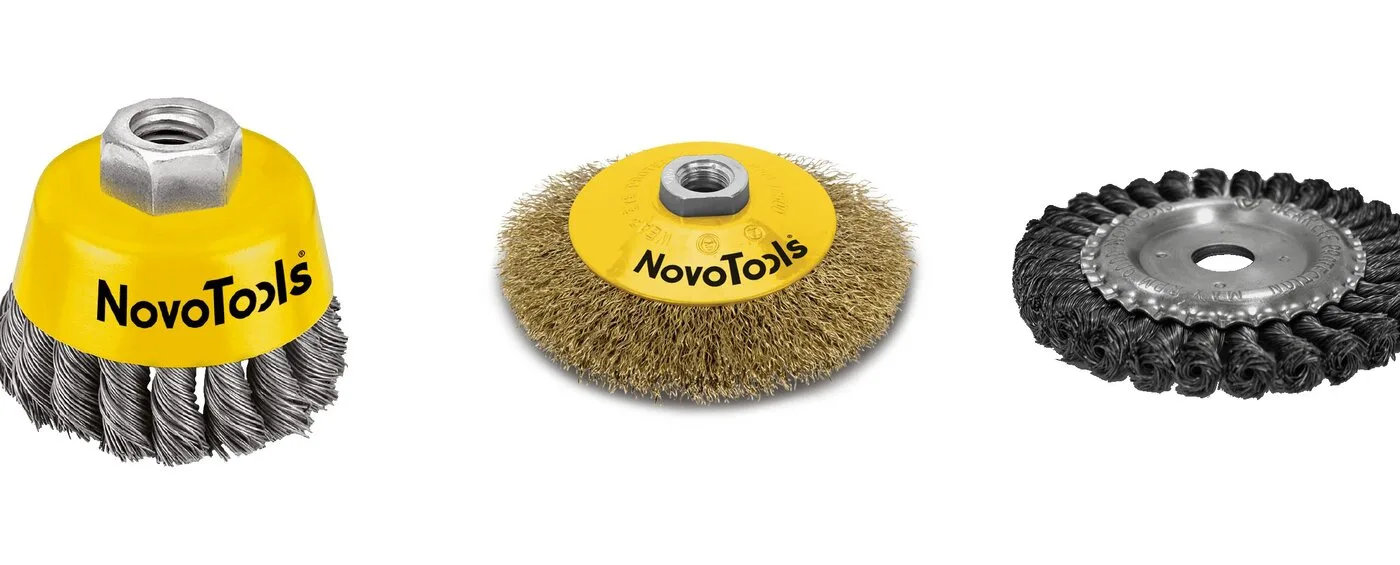
A wire brush is the fastest way to remove rust, old paint and scale without removing the metal itself. But not all brushes are equal: a cup works with its face, a wheel with a narrow edge, a bevel brush at an angle. Take not the one at hand but the one that matches the shape of the surface.
Three brush shapes and where they go
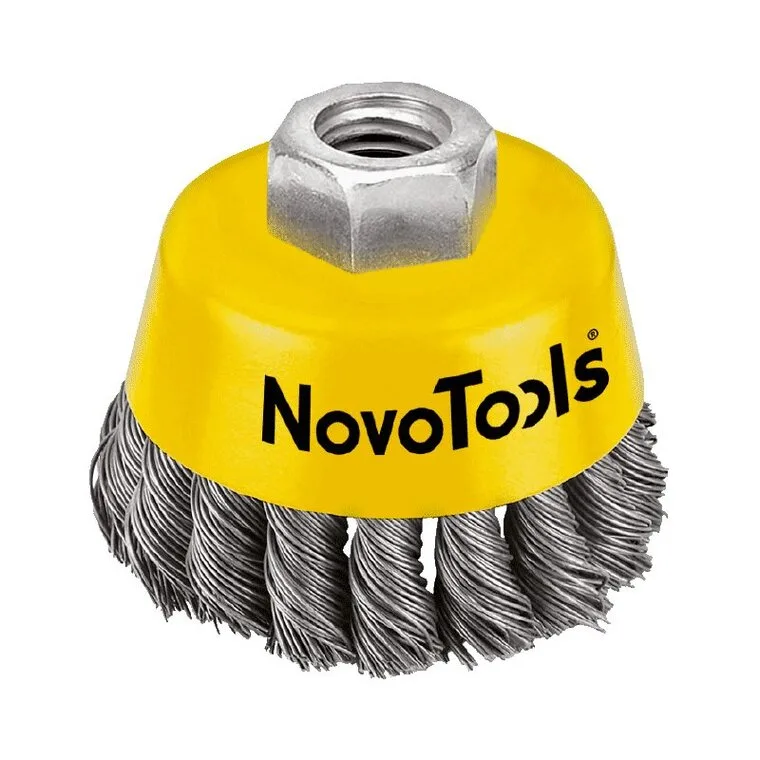
Cup brush. Bundles of wire are fixed around a steel cup and face forward. It works with its face, covering a strip as wide as its own diameter per pass — 65–125 mm. This is the tool for large surfaces: sheets, beams, tanks, car bodies, wherever rust or paint has to come off a flat area. It mounts with an M14 thread, no nut or flanges.
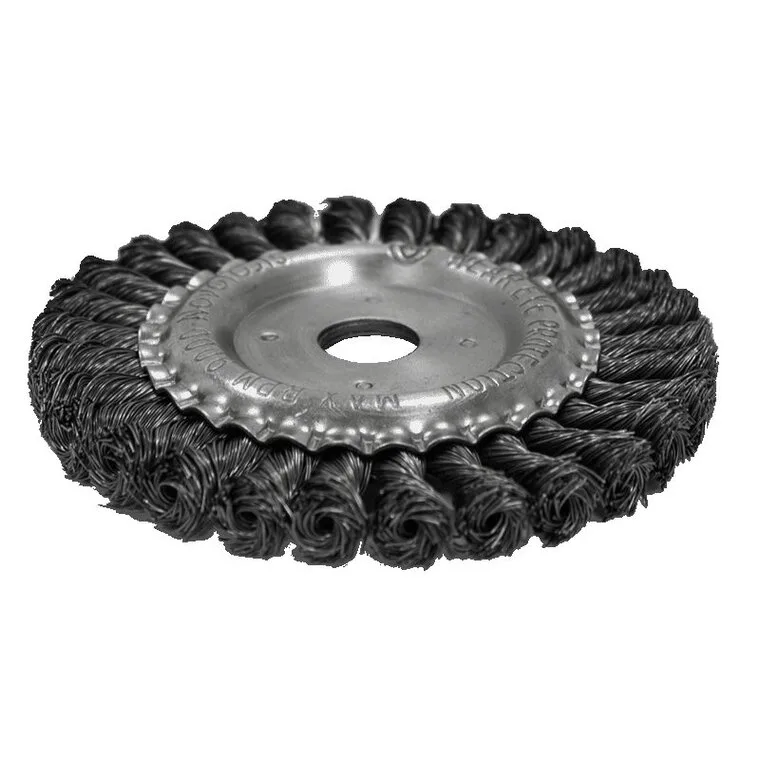
Wheel (ring) brush. The wire stands along the rim of a thin disc and works with an edge only 10–20 mm wide. It reaches where a cup cannot: weld seams, grooves, profile joints, inside corners. The NovoTools wheel brush 175×22.2 mm is rated for 8 000 rpm — that is a bench machine or a low-speed tool; it must not be fitted to 125 and 180 mm angle grinders (11 000–12 000 and 8 600 rpm).
Bevel brush. The wire is spread in a cone, the working part is the bevelled edge. It works at an angle, so it suits chamfers, edges, corners of welded structures and curved parts. It mounts on a 125 mm grinder with an M14 thread, diameters 100–125 mm.
There are also drill brushes on a 6 mm shank — 75 mm cup brushes and sets of 4 and 6 pieces for small parts, threads and hard-to-reach places.
Table: job → shape → wire
| Task | Brush shape | Wire | Diameter |
|---|---|---|---|
| Rust, scale, thick old paint on sheet or beam | Chashkova | Knotted 0.5 mm | 100–125 мм |
| Light rust, thin sheet, preparation for primer | Chashkova | Crimped 0.3 mm | 65–100 mm |
| Weld seam, slag, spatter | Bevel or wheel | Knotted | 100–125 mm (bevel), 175 mm (wheel on a bench machine) |
| Edges, chamfers, inside corners | Bevel | Knotted or crimped | 100–115 mm |
| Threads, holes, small parts | Drill brush (6 mm shank) | Crimped or knotted | 75 mm, sets of 4–6 pcs. |
| Heavy cleaning of castings, build-ups | Cup with a support ring | Reinforced knotted 0.5 mm | 65–100 mm |
Knotted or crimped wire
- Knotted (twisted) wire 0.5 mm. The wires are twisted into tight knots — the brush is stiff and aggressive and holds its shape for a long time. For scale, thick rust, welding slag, castings.
- Crimped wire 0.3 mm. The wavy wires stand separately — the brush is softer, follows the contour and does not scratch thin metal. The brass coating protects the wire from corrosion. For light rust, preparation for painting, non-ferrous metals.
- Reinforced knotted wire with a support ring. A steel ring supports the knots from below so the brush does not open under load — for the heaviest work.
Speed, mounting and safety
- The maximum speed on the brush is the law. NovoTools cup and bevel brushes of 100 and 125 mm are rated for 11 000 rpm, the 65–90 mm brushes and the 115 mm bevel brush for 12 000–12 500. A standard 125 mm grinder runs at 11 000–12 000 rpm: check the nameplate speed of your tool — if it is above the brush rating, take a smaller brush or a grinder with speed control. The 175 mm wheel brush is rated for only 8 000 rpm: it must not be fitted to 125 and 180 mm grinders.
- M14 mounting— the brush screws straight onto the spindle, no nut. Tighten by hand to the stop; the tool will tighten it further in use.
- The guard stays on. Wires break off and fly at disc speed — guard, face shield, gloves and tight clothing are mandatory.
- Spin up off the workpiece. Let the brush reach speed at no load and only then bring it to the metal.
The full list of rules is in the angle grinder safety guide and the recommended speed table.
How to work so the brush does not "go bald"
- Work with the wire tips. It is the ends of the wires that cut. Pressing hard bends the wire, it works sideways, heats up and breaks — the brush "goes bald" twice as fast and the surface comes out worse.
- Cup brush — at 10–15° to the surface, not flat: that way the front edge of the cup works, not the whole face.
- Wheel brush — edge only. Side load opens the wheel and breaks the wire out.
- Move against the rotation in short strokes so the wire does not get "clogged" with paint.
- Flip the wheel brush on a bench machine on its axle from time to time — the wire wears more evenly on both sides.
NovoTools brushes
The NovoTools range has 25 wire brushes: cup brushes of 65, 75, 85, 90, 100 and 125 mm with knotted, crimped brass-coated and reinforced knotted wire with a support ring; bevel brushes of 100, 115 and 125 mm; a 175×22.2 mm wheel brush for bench machines; drill brush sets of 4 and 6 pieces. All brushes for angle grinders have an M14 thread; maximum speed — 11 000 rpm for 100 and 125 mm, 12 000–12 500 for 65–90 mm and the 115 mm bevel brush.
Frequently asked questions
Which wire brush is best for removing rust?
For thick rust and scale on a flat surface — a cup brush with 0.5 mm knotted wire. For a light film and thin sheet — a cup brush with 0.3 mm crimped wire, it does not scratch the metal.
Does a 125 mm brush fit a 125 mm grinder?
Yes, if the brush has an M14 thread and its maximum speed is not below the nameplate speed of the grinder. NovoTools 100 and 125 mm brushes are rated for 11 000 rpm, while 125 mm grinders run at 11 000–12 000: for a tool with higher speed take a 65–90 mm brush (12 000–12 500 rpm) or a grinder with speed control.
How does a bevel brush differ from a cup brush?
On a bevel brush the wire is spread at an angle and the bevelled edge works: it gets into corners, chamfers and edges where a flat cup does not sit. A cup brush covers a larger area and cleans flat surfaces faster.
Can a wire brush be used on stainless steel?
Only with a stainless-wire brush that has not been used on carbon steel (not currently in the NovoTools range). Ordinary steel wire leaves iron particles in the surface and the stainless steel gets covered in rust spots.
Why does a brush lose its wire quickly?
Three causes: too much pressure (the wire works sideways and breaks), side load on a wheel brush and exceeded speed. Work with the wire tips, at 10–15°, and do not exceed the speed stated on the brush.
Metal brushes NovoTools
Cup, bevel and wheel brushes with knotted and crimped wire, drill sets. Wholesale prices from the manufacturer.
Go to the catalog