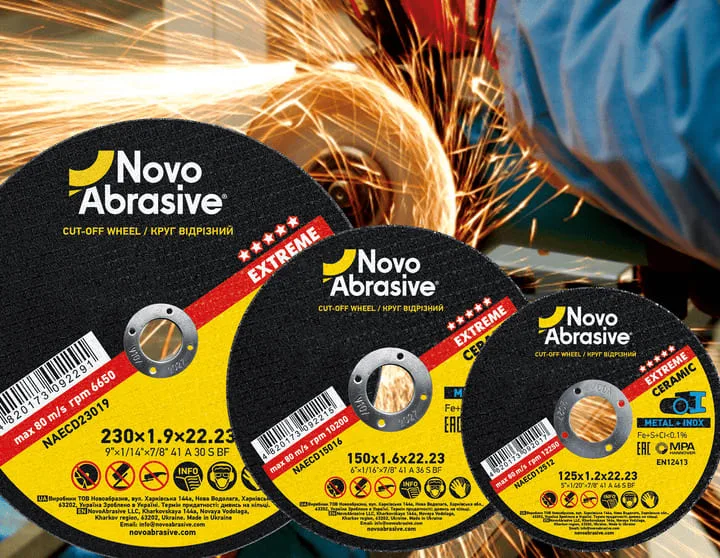
What is a Cutting disc and what does it consist of?
A Cutting disc is a thin, reinforced disc that is mounted on an angle grinder (grinder) for cutting metal, stone, and other materials. The principle of operation is simple: abrasive grains, fixed in a bundle, remove material at high speed - up to 80 m/s.
The design consists of three components:
- Abrasive grain is a cutting element. The type of grain determines which materials can be processed and with what productivity.
- Bond (Bakelite resin) - holds the grains in the disc structure. The service life and wear rate depend on the hardness of the bond.
- Reinforcing fiberglass mesh - one or two fiberglass meshes provide mechanical strength and safety during rotation.
Cut-off discs come in two types according to the ISO standard: Type 41 (flat) and Type 42 (with a recessed center). Type 42 is more convenient for hand grinders - it allows you to cut closer to the surface without touching the flange.
Step 1 — Determine the finishing material
This is the most important criterion. The wrong choice not only reduces efficiency, but can also be dangerous. Each material requires its own type of abrasive grain.
| Material | Grain type | Marking | What to look out for |
|---|---|---|---|
| Steel, ferrous metal | Aluminum oxide (Al₂O₃) | A | The most common option. Suitable for fittings, pipes, profiles |
| Stainless steel (INOX) | Zirconia or ceramic | AS INOX, ZA INOX | Must be free of Fe and S. Only discs marked INOX |
| Stone, concrete, brick | Silicon carbide (SiC) | C | Or use diamond blades - they last longer. |
| Aluminum, copper | Aluminum oxide | A | Choose a soft connection - non-ferrous metals clog the disc |
| Reiki | Aluminum oxide, special formulation | A 24 N BF | Three-layer reinforcement, 100 m/s, diameter 350–400 mm |
Step 2 — Choose the diameter of the disc
The diameter of the Cutting disc should match the power of your angle grinder. The most popular sizes in Ukraine are 125 mm and 230 mm. Here is the full table:
| Diameter | Landing | Power of the grinder | Depth of cut | Typical tasks |
|---|---|---|---|---|
| 115 mm | 22.23 mm | 600–800 W | up to 25 mm | Thin profile, wire, small works |
| 125 mm | 22.23 mm | 800–1200 W | up to 35 mm | Universal: pipes, fittings, sheet metal |
| 150 mm | 22.23 mm | 1200–1500 W | up to 45 mm | Medium diameter pipes, thick profile |
| 180 mm | 22.23 mm | 1500–2000 W | up to 55 mm | Large pipes, beams, industrial tasks |
| 230 mm | 22.23 mm | from 2000 W | up to 70 mm | Heavy work: I-beams, channels, rails |
| 300–400 mm | 25.4/32 mm | Stationary | up to 130 mm | Cutting machines, gas cutters, rail cutters |
Step 3 — Choose the thickness
The thickness of the Cutting disc affects three things: cutting speed, workpiece heating and wheel life. The rule is simple: thinner = faster and cooler, thicker = longer life.
| Thickness | For what? | Advantages | Limitation |
|---|---|---|---|
| 0.8–1.0 mm | Sheet metal, profile, INOX | Minimum heat, fastest cut | Requires careful work, not for large cross-sections |
| 1.2–1.6 mm | Pipes, fittings up to 15 mm | Optimal balance of speed and resource | A little more metal waste |
| 2.0–2.5 mm | Fittings, profiles, pipes 15–30 mm | High resource, stable cutting | Greater heating of the workpiece |
| 3.0–3.2 mm | Stationary machines, large cross-sections | Maximum resource | Only for powerful equipment |
Step 4 — Abrasive Grain Type
The type of grain determines the performance, life and cost per cut. NovoAbrasive uses three types of grain in three product series:
| Grain type | Series | Resource* | Relative price | For whom |
|---|---|---|---|---|
| Aluminum oxide (Al₂O₃) | Standard | 15–25 cuts | 1x | Household use, one-time jobs |
| Zirconium (ZrO₂) | Profi | 30–45 cuts | 1.3–1.5x | Professionals, daily work |
| Ceramics (SG) | Extreme | 50–70 cuts | 1.8–2.2x | Industrial use, large volumes |
* Test: cutting 12 mm rebar, 125×1.0 mm wheel. Actual life depends on material and operating conditions.
Aluminum oxide (Standard)
The most common and affordable abrasive. Works well on ordinary steel and ferrous metals. Optimal for intermittent use - repairs, home workshops, one-time tasks.
Zirconium (Profi)
Has the property of self-sharpening: during operation, the grain chips off, exposing new sharp edges. This provides stable performance throughout the entire service life. Lasts 2–3 times longer than aluminum oxide. Ideal for daily work - welders, locksmiths, installers.
Ceramics (Extreme)
The most technologically advanced abrasive. The microcrystalline structure provides a cool cut with minimal heating of the workpiece. Maximum resource and productivity. Although the price is higher, the cost per cut in Extreme is the lowest among the three series.
Step 5 — Grain and Bonding
These parameters are less often chosen by the end user - usually the manufacturer selects the optimal combination for each type of disk. But understanding them will help you make an informed choice.
Grit
Indicates the size of the abrasive grains. The smaller the number, the coarser the grain and the faster the cut:
- 24–30— coarse grain. Fast cutting of thick metal. Coarse edge.
- 36–46— average. Most common option for Cut-off discs. Balance of speed and cut quality.
- 60–80— fine. For finishing cuts in thin sheet metal. Less burrs.
For most tasks, grit 30–46 is the optimal choice.
Bond
Cut-off discs use a Bakelite bond (BF), a resin reinforced with fiberglass. The hardness of the bond determines how quickly the wheel wears out:
- Soft bond - the grain is released faster, the wheel is self-sharpening. Cuts hard metals better. Shorter resource.
- Hard bond— grain lasts longer, longer life. But can overheat on hard metals.
How to read the marking (EN 12413)
Each Cutting disc certified according to the European standard EN 12413 has mandatory marking. Let's look at an example:
| Element | Value | Explanation |
|---|---|---|
| A | Grain type | A = Aluminum Oxide, C = Silicon Carbide, ZA = Zirconium, AS = Blend/Special |
| 30 | Grit / Grain Size | From 16 (coarsest) to 120 (finest). 24–46 is typical for cutting |
| S | Bond strength | Scale from A (soft) to Z (hard). R–T is the medium range for cutting |
| BF | Connection type | BF = Bakelite Fiber-reinforced — standard for cut-off |
In addition to the specification, the disc must indicate:
- Dimensions— outer diameter × thickness × mounting hole (e.g. 125×1.0×22.23 mm)
- Maximum speed— in m/s and RPM (e.g. 80 m/s, 12,200 rpm)
- Expiration date— expiration or production date (usually 3 years)
- Safety pictograms - mandatory according to EN 12413
- Certification marks— MPA, oSa, EN 12413
Three NovoAbrasive series - comparison
NovoAbrasive produces Cutting discs in three series, each optimized for its own usage scenario:
| Parameter | Standard | Profi | Extreme |
|---|---|---|---|
| Grain | Aluminum oxide | Zirconium-corundum | Ceramics SG |
| Resource (cuts)* | 15–25 | 30–45 | 50–70 |
| Cost per cut | Medium | Lower | Lowest |
| Heating the workpiece | Moderate | Low | Minimum |
| For INOX | No | Yes (INOX series) | So |
| Certification | EN 12413, part | EN 12413, MPA, part | EN 12413, MPA, part |
* Test: 12 mm reinforcement, 125×1.0 mm disc. Data from NovoAbrasive Technical Department, 2025.
7 mistakes when choosing a Cutting disc
- The disc is larger in diameter than the grinder. The protective cover is removed to install a 230 mm disc on a 125 mm grinder. The linear speed exceeds the permissible one - risk of rupture.
- Cutting stainless steel with a regular blade. The iron and sulfur in the composition contaminate the cut area. After weeks, rust appears exactly where the cut was made.
- Using a Cutting disc for grinding. Side load that the thin disc is not designed for. May splinter in the hands.
- Working without a protective casing. When breaking, fragments fly at speeds of up to 80 m/s. A casing is always required.
- Expired. Bakelite binding absorbs moisture and loses strength. Check the date on the label.
- Choose only by price. A cheap wheel with a resource of 15 cuts costs more per cut than a quality one with a resource of 50 cuts. Calculate the cost of the cut, not the disc.
- Ignoring RPM. The maximum speed of the wheel should be NO LESS than the speed of the grinder. A wheel at 12,200 RPM on a grinder with 13,000 RPM is dangerous.
Frequently asked questions
What thickness of Cutting disc should I choose?
For thin sheet metal and profiles, choose 1.0–1.6 mm— they cut faster with minimal heating. For pipes and fittings 10–20 mm, 2.0–2.5 mm discs are suitable. For stationary machines and large cross-sections — 3.0 mm and more.
Can I cut stainless steel with a regular Cutting disc?
No. Conventional wheels contain iron and sulfur, which contaminate the cutting area and cause corrosion. For stainless steel, use only wheels marked INOX - they do not contain Fe and S, which preserves the anti-corrosion properties of the metal.
What is the difference between 125 mm and 230 mm wheels?
125 mm disc is the most popular size for hand grinders 800–1200 W with a cutting depth of up to 35 mm. 230 mm disc is for powerful machines from 2000 W with a cutting depth of up to 70 mm. Choose the diameter according to the power of your tool - never exceed the maximum permissible diameter.
How many cuts does one Cutting disc make?
Depends on the series and material. When cutting 12 mm reinforcement with a 125×1.0 mm wheel: Standard— 15–25 cuts, Profi— 30–45 cuts, Extreme— 50–70 cuts. The cost of one cut is the lowest for Extreme, despite the higher price of the disc.
What does the A 30 S BF marking on the cutting disc mean?
A— grain type (aluminium oxide), 30— grit size (medium), S— bond hardness (medium), BF— bond type (bakelite reinforced with glass mesh). This is a standard marking according to EN 12413. For more information, see our glossary of abrasive terms.
Need help choosing?
Use our Product Finder or get technical advice