What is a flap disc?
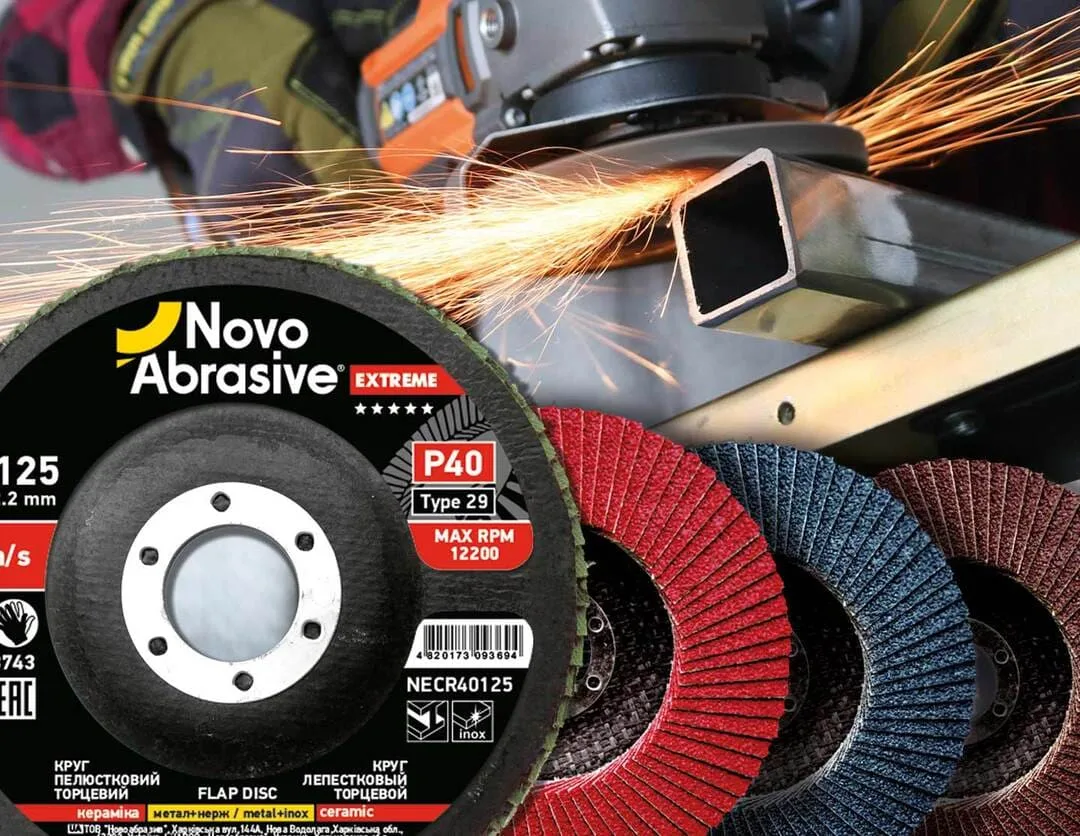
A flap disc (also known as a flap disc or flap disc ) is an abrasive grinding disc consisting of overlapping pieces (flaps) of abrasive paper mounted on a rigid backing. The flaps are arranged in a "fan" pattern, similar to a deck of cards, hence the German name, which literally means "fan washer".
The design consists of three components:
- Flaps are rectangular pieces of sanding paper (abrasive grain on a fabric base). The service life depends on the quality of the fabric and the type of grain. The flaps overlap each other by 50–70%, which ensures uniform contact with the workpiece.
- The base (plate) is a hard disk made of fiberglass or fiber, on which the flaps are attached. The shape of the base determines the type of wheel: flat (Type 27) or conical (Type 29).
- The mounting hole is standard 22.23 mm for angle grinders. The wheel is mounted directly on the spindle, a support plate is NOT required.
How it works: As the flaps rotate, they contact the workpiece surface and cut micro-chips. As they wear, the top layer of the flap is worn away, exposing fresh grain from the bottom layer. This self-sharpening effect ensures consistent performance throughout its life - the flap wheel grinds evenly from the first to the last second.
Flat vs. conical - which shape to choose
This is the first decision when choosing. The two types differ in the shape of the base and the angle of operation.
Flat (Type 27 / T27 / Flat)
The base is flat, the flaps are located in the same plane as the base.
Advantages:
- Maximum contact area when working at a small angle (5–15°)
- Ideal for processing large flat surfaces
- Convenient for "stretching" the surface (finishing)
- Ability to work with the end face for corner processing
Best suited for:
- Sanding of flat sheets and panels
- Removal of paint and coatings on large areas
- Finishing sanding for painting
- Finishing countertops, floors, decks
Conical (Type 29 / T29 / Conical)
The base has the shape of a shallow cone (tilt angle ~15°).
Advantages:
- Better access to inside corners and edges
- Optimal contact angle with standard hand position (15–25°)
- More aggressive metal removal at the same pressure
- More convenient for cleaning welds
Best suited for:
- Cleaning welds (most common application)
- Corner joint processing
- Removing scale and burrs
- Grinding of pipes and profiles
Comparison table
| Parameter | Flat (T27) | Conical (T29) |
|---|---|---|
| Working angle | 5–15° | 15–25° |
| Contact area | Maximum | Medium |
| Aggressiveness | ★★★☆☆ | ★★★★☆ |
| Flat surfaces | ★★★★★ | ★★★☆☆ |
| Welded seams | ★★★☆☆ | ★★★★★ |
| Corners and edges | ★★☆☆☆ | ★★★★★ |
| Pipes and profiles | ★★★☆☆ | ★★★★☆ |
Step 1 — Choose the type of grain
The abrasive grain determines what materials the wheel will work effectively with and how long it will last.
Corundum (aluminum oxide, AO)
Basic grain with a good price-quality ratio.
- Works well on carbon steel, cast iron, wood
- Lowest price per disc
- Suitable for household tasks and infrequent work
- NOT recommended for stainless steel
Choose corundum if: you work infrequently (several times a month), only with carbon steel, and your budget is limited.
Zircon (zirconium corundum, ZA)
Improved grain with self-sharpening effect.
- Lifespan 2–3 times longer than corundum
- Self-sharpening - when loaded, the grain chips away, exposing a new sharp edge
- Works at high pressure without "clogging"
- Suitable for stainless steel and heat-resistant alloys
- Heats the part less
Choose zircon if: you work every day (professional use), you work with stainless steel, you need maximum service life.
Comparison of grains for flap discs
| Parameter | Corundum (AO) | Zircon (ZA) |
|---|---|---|
| Price per disc | ★★★★★ | ★★★☆☆ |
| Resource | ★★☆☆☆ | ★★★★★ |
| Productivity | ★★★☆☆ | ★★★★★ |
| Carbon steel | ✔ | ✔ |
| Stainless steel | ❌ | ✔ |
| Aluminum | ⚠️ gets clogged | ⚠️ gets clogged |
| Wood | ✔ (P80+) | ✔ (P80+) |
| Self-sharpening | No | So |
Step 2 — Determine the grain size
| Grit / Grain Size | For what? | Typical application |
|---|---|---|
| P40 | Rough removal | Cleaning welds, removing old paint, rust |
| P60 | Medium grinding | Surface leveling, descaling |
| P80 | Semi-finished | Preparation for painting, leveling |
| P100 | Cleanliness | Preparation for priming |
| P120 | Finishing | Finishing, decorative polishing of stainless steel |
The three most popular numbers:
- P40— for welders (No. 1 in sales)
- P60 - universal (suitable for most tasks)
- P80— for painters and finishers
Step 3 — Choose the diameter
The diameter of the flap disc should match your grinder.
| Diameter | Bore | Max. RPM | angle grinder woman |
|---|---|---|---|
| 115 mm | 22.23 mm | 13,300 rpm | Compact, 700–1000 W |
| 125 mm (most popular) | 22.23 mm | 12,200 rpm | Standard, 800–1200 W |
| 150 mm | 22.23 mm | 10,200 rpm | Medium, 1200–1500 W |
| 180 mm | 22.23 mm | 8,500 rpm | Powerful, 1500–2000 W |
The most popular diameter is 125 mm. It is suitable for most household and professional tasks. If you have a standard grinder, choose 125 mm.
180 mm - for large areas and powerful grinders. Larger contact area = higher productivity on large parts.
Flap vs fiber vs strip
Three types of grinding wheels for angle grinders solve different problems. Here's how to choose:
| Task | Flap | Fiber | Sweeping |
|---|---|---|---|
| Welded seams | ✔ The best | ✔ Okay | ✔ Okay |
| Finishing | ✔ The best | ⚠️ Average | ❌ Rough |
| Large area | ⚠️ Expensive | ✔ The best | ❌ Rough |
| Stainless steel | ✔ The best | ✔ Okay | ⚠️ Overheating |
| Rough removal | ⚠️ Slowly | ✔ Okay | ✔ The best |
| Paint removal | ✔ Okay | ✔ Okay | ✔ Fast |
| Comfort | ✔ Quiet, low vibration | ⚠️ More vibration | ❌ Noise and vibration |
| Plate | No | So | No |
| Price | Medium | Lowest | Higher |
For what work to use
Welding work
- Weld cleaning - conical T29, P40, zircon. This is the #1 job for flap wheels. The conical shape allows you to reach the weld in corners and near edges.
- Edge preparation - P60, corundum or zircon. Clean edge without rust and scale = high-quality weld.
- Spatter removal - P40–P60. The flap wheel removes spatter more delicately than the sanding wheel, without leaving deep scratches.
Stainless steel processing
- Cleaning welds on stainless steel - P60, Zirconium ONLY. Corundum can cause corrosion in the treatment area.
- Creating a satin texture - P80–P120, zircon. Sand in one direction parallel to the rolling lines.
- Removing runny colors— P60–P80, zircon. Uniform movements without stopping.
Preparing for painting
- Removing old paint— P40–P60, corundum. Coarse grain quickly removes old paint.
- Rust removal— P40–P60, zircon. Zircon works more effectively on rust because it doesn’t clog.
- Leveling the surface for paint - P80, corundum or zircon. This is the optimal roughness for paint adhesion.
- Preparation for primer - P100–P120. Smooth surface for an even primer layer.
Wood
- Sanding wood - P80–P120, corundum ONLY. At low speed (6000–8000 rpm). Work at a minimum angle (5–10°) and without strong pressure.
- Varnish removal— P60–P80, corundum. Coarse grit removes old finish more effectively.
Work technique
Bevel angle: 15–25° for conical (T29), 5–15° for flat (T27). This is a key difference from grinding wheels which require 30–40°. Smaller angle = larger contact area = more even result.
Pressure: Light and even. The flap wheel works by speed, not pressure. Excessive pressure will overheat the workpiece (especially stainless steel), shorten the life of the flaps, and degrade the surface quality.
Movement: Smooth, with 30–50% overlap between passes. Avoid stopping in one place — this creates “pits” in the surface. Move evenly, like a paint roller.
Speed: Full speed of the grinder (11,000–12,200 rpm for 125 mm). For stainless steel, you can reduce to 9,000–10,000 rpm if the grinder has an adjustment.
Direction: For best results, sand "away from you" - this way the chips and sparks fly away from you, not at you.
Common mistakes
- Excessive pressure. The most common mistake. A flap wheel is not a sanding wheel. It works by using sanding paper, not abrasive material. Strong pressure tears off the flaps and overheats the part.
- Angle too large. Working at 40–50° is the angle for a grinding wheel. A flap wheel at this angle only works on the edge, wears unevenly, and produces a wavy surface.
- Corundum on stainless steel. Corundum wheels may contain iron impurities, which when heated are transferred to stainless steel and cause corrosion. For INOX - only zirconium.
- Stopping in one place. Stopping the grinder in one spot creates a localized indentation. Always move the tool around—even if you need to remove more material in one spot, do it in multiple passes.
- Using a worn wheel. When the flaps have worn down to the base, the wheel needs to be replaced. The base (fiberglass) only heats the surface and can leave scratches.
- Wrong grit. P120 on a weld is inefficient and slow. P40 for finishing is too coarse. Choose the grit for the specific task.
- Ignoring protective equipment. When grinding with a flap disc, fine metal dust is formed. Required: safety glasses, a respirator (especially when working with stainless steel - chrome dust is carcinogenic), gloves.
NovoAbrasive flap discs
NovoAbrasive produces conical type flap discs (T29) in two grain options:
All NovoAbrasive products are manufactured in accordance with ISO 9001 and certified for use at speeds up to 12,200 rpm (for 125 mm) and 13,300 rpm (for 115 mm).
Frequently asked questions
What is a flap disc and how does it differ from a sweep disc?
Flap wheel (lamella, flap) - a grinding wheel made of overlapping pieces of sanding paper. A finishing (grinding) wheel - a monolithic abrasive wheel 6–8 mm thick. Flap wheels work softer: they give better surface quality, heat the part less, and create less noise and vibration. Finishing wheels - remove large amounts of metal faster.
Flat or conical - which one to choose?
Tapered (Type 29) - for 80% of tasks: welds, edges, structures. Flat (Type 27) - for large flat surfaces: sheet metal, panels, decks. When in doubt, choose the tapered, it is more versatile.
Zircon or corundum - which is better?
Zircon is more expensive per unit, but the resource is 2–3 times longer. For daily work, zircon is more profitable: the cost of processing one square meter is lower. For stainless steel - only zircon. Corundum - for household use and infrequent work on carbon steel.
What grit should I choose for a weld?
P40 for cleaning the seam, P60 for leveling, P80 for preparing for painting. The sequence P40 → P60 → P80 gives the best result. If the seam is not high, you can start with P60.
Can wood be sanded?
Yes, but only with a grit of P80 and finer. Coarse grit (P40) tears the wood fibers. Work at low speed (6000–8000 rpm), at a minimum angle (5–10°) and without strong pressure. For soft species (pine) it is better to use special grinding discs.
At what angle should I work?
Tapered (T29): 15–25° to the surface. Flat (T27): 5–15°. This is significantly less than for a grinding wheel (30–40°). Smaller angle = larger contact area = smoother surface. Don’t press too hard – let the abrasive do the work.
Is a backing plate needed for a flap disc?
No, the flap disc is self-supporting. It is attached directly to the grinder spindle using a clamping nut. A backing plate is only needed for fiber discs.
Choose a flap disc
Use the Product Finder or browse the full NovoAbrasive flap disc catalog