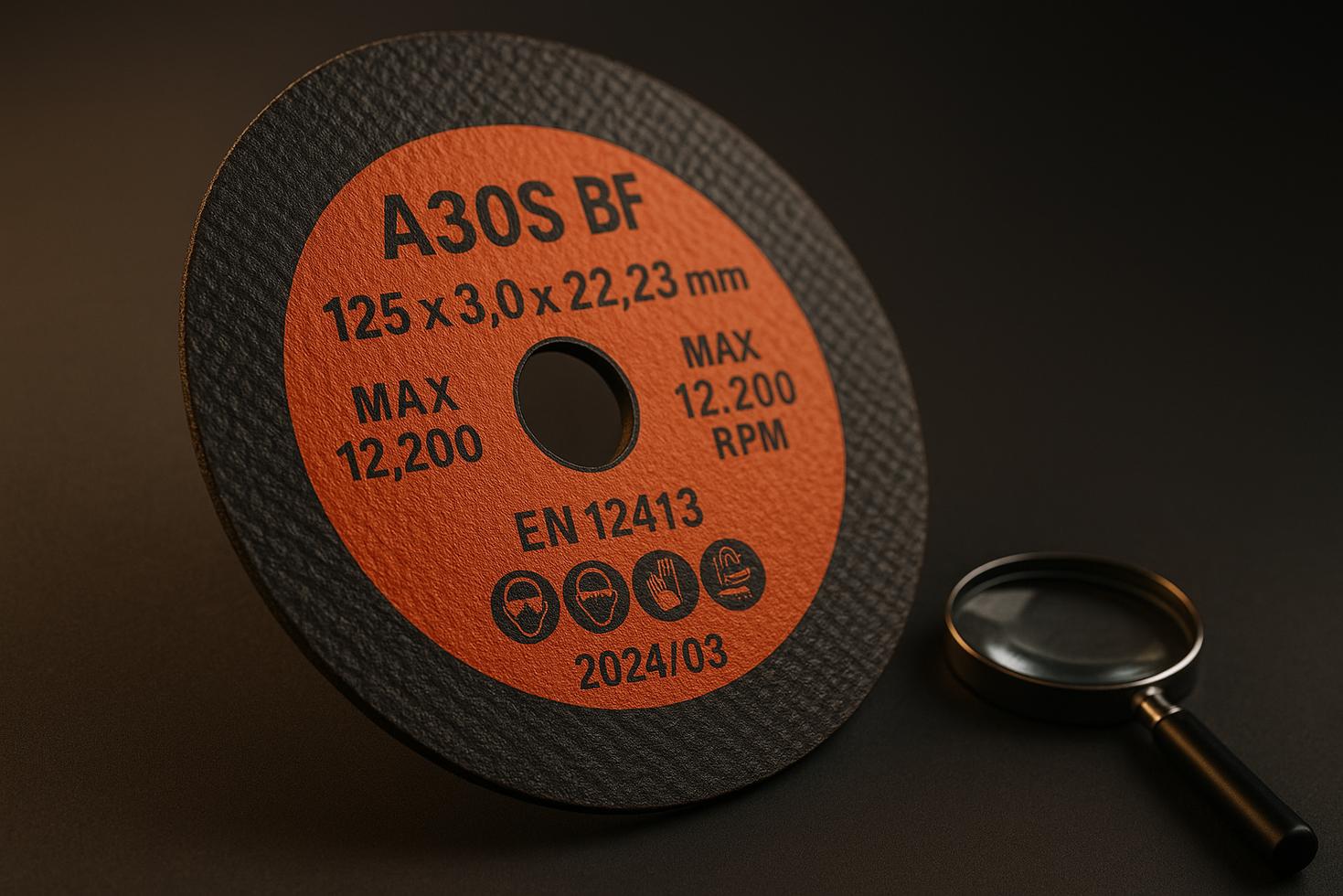
12 mandatory labeling elements
Every abrasive disc sold in the EU and Ukraine must be marked in accordance with the EN 12413 standard (Safety of bonded abrasive tools). This is your disc's "passport" - it provides all the information you need for safe operation.
Specification decoding: grain, grit size, hardness, bond
The abrasive disc specification is a 4-element code that describes the main characteristics of the abrasive. Let's look at each element in detail.
Abrasive grain type
The first letter in the specification determines the material from which the cutting grains are made:
| Marking | Grain type | For which materials | NovoAbrasive Series |
|---|---|---|---|
| A | Aluminum oxide (Al₂O₃) | Steel, ferrous metal, cast iron | Standard |
| C | Silicon carbide (SiC) | Stone, concrete, brick, glass | Standard |
| FOR | Zirconium-corundum | Steel, stainless steel (INOX), intensive work | Profi |
| AS | Special/Ceramic (SG) | Alloy steels, INOX, industrial use | Extreme |
Grit Size
The number after the grit type indicates the size of the abrasive particles. The smaller the number, the coarser the grit:
| Grit / Grain Size | Grain size | Typical use |
|---|---|---|
| 16–20 | Very rude | Rough grinding, removal of large allowances |
| 24–30 | Rough | Cutting thick metal, stripping welds |
| 36–46 | Average | Most common for cutting discs |
| 60–80 | Thin | Finishing cutting, sanding for painting |
| 100–120 | Very thin | Finishing, polishing |
Bond Hardness (Hardness Grade)
The letter A to Z indicates how tightly the bond holds the abrasive grains. This affects the speed at which the disc self-sharpens:
| Range | Hardness | Characteristic | For what tasks |
|---|---|---|---|
| A–H | Soft | The grain is released quickly, the disc is self-sharpening | Hard metals, large contact areas |
| I–Q | Medium | Balance of resource and productivity | General application |
| R–T | Medium-hard | Increased resource, stable cutting | Cutting discs, stationary equipment |
| U–Z | Solid | Maximum resource, requires power | Soft materials, large cross-section |
Bond type (Bond)
The last element of the specification is the type of bond holding the grains:
- BF - Bakelite Fibre-reinforced. Standard for cutting and grinding discs. Reinforced with one or two layers of fibre mesh.
- V— vitrified (ceramic). Used in grinding discs and some specialty products.
- B - Bakelite without reinforcement. Rarely found for manual machines.
Visual example of marking
Let's break down the typical specification you'll see on a NovoAbrasive abrasive disc:
This specification means: Aluminum oxide disc, medium grit, medium-hard bond, reinforced with fibre mesh. This is the most common option for cutting and grinding structural steel.
Other common specifications:
- A 46 T BF— finer grain, harder bond. Thinner cutting discs (1.0–1.6 mm) for a clean cut.
- ZA 24 R BF— zirconium, coarse grain, medium hardness. Profi series grinding discs.
- AS 46 S BF— ceramic grain, medium grain. Extreme series discs for INOX.
- C 24 S BF— silicon carbide for stone and concrete.
Dimensions: D×T×H format
The dimensions of the abrasive disc are written in the format D × T × H, where:
- D is the outer diameter (mm). It determines which grinder the disc is intended for.
- T— thickness (mm). Affects cutting speed and resource.
- H is the diameter of the mounting hole (mm). The standard for manual grinders is 22.23 mm.
For example, 125 × 1.0 × 22.23 means: diameter 125 mm, thickness 1.0 mm, fit 22.23 mm.
| Diameter (D) | Typical thicknesses (T) | Landing (H) | Tool type |
|---|---|---|---|
| 115 mm | 1.0, 1.2, 1.6, 6.0 | 22.23 mm | Hand grinder 600–800 W |
| 125 mm | 0.8, 1.0, 1.2, 1.6, 2.0, 2.5, 6.0, 6.4 | 22.23 mm | Hand grinder 800–1200 W |
| 150 mm | 1.6, 2.0, 2.5 | 22.23 mm | Hand grinder 1200–1500 W |
| 180 mm | 1.6, 2.0, 2.5, 3.0, 6.0, 8.0 | 22.23 mm | Hand grinder 1500–2000 W |
| 230 mm | 1.9, 2.0, 2.5, 3.0, 6.0, 8.0 | 22.23 mm | Hand grinder from 2000 W |
| 300–400 mm | 3.0, 3.5, 4.0 | 25.4 / 32 mm | Stationary machines, gas cutters |
Speed: m/s and RPM
Each disc shows two speed characteristics:
- Linear speed (m/s) is the speed of movement of the abrasive grain on the periphery of the disc. The standard value for most discs is 80 m/s. Special discs for rake cutters are 100 m/s.
- Rotational speed (RPM)— the maximum allowable revolutions per minute. Depends on the diameter of the disc at the same linear speed.
| Disc diameter | Max RPM (at 80 m/s) | Typical RPM grinders |
|---|---|---|
| 115 mm | 13,300 rpm | 11 000–13 000 |
| 125 mm | 12,200 rpm | 10 000–12 000 |
| 150 mm | 10,200 rpm | 9 000–10 000 |
| 180 mm | 8,500 rpm | 7 500–8 500 |
| 230 mm | 6,650 rpm | 6 000–6 600 |
Safety icons
The EN 12413 standard requires pictograms to be placed on each disc indicating the required personal protective equipment (PPE). These symbols are international and are understandable without text:
- Safety glasses are mandatory for any work with abrasive discs. Standard EN 166.
- Protective cover - the disc cannot be used without a protective cover on the grinder.
- Hearing protection - the noise level during operation exceeds 85 dB.
- Gloves - protection against sparks, hot fragments and vibrations. Standard EN 388.
- Respirator - abrasive dust is generated during work. Standard EN 149 (minimum FFP2).
- Prohibition of the use of damaged discs - a disc with cracks, chips or deformation must be disposed of.
How to check the expiration date
Bakelite bonded (BF) abrasive discs have a limited shelf life. The Bakelite resin absorbs moisture from the air over time, which reduces the mechanical strength of the disc.
The expiration date is indicated on the label in MM/YYYY (month/year) format. The standard shelf life is 3 years from the date of manufacture.
Proper storage (FEPA recommendations)
- Temperature: 18–22 °C (without sudden changes)
- Humidity: 45–65% (not in damp basements)
- Position: horizontally on a flat surface, in original packaging
- No load: do not place heavy objects on top of the pack of discs
- No direct sun: UV radiation degrades the bond
INOX marking: what does it mean?
The INOX marking on an abrasive disc is not just a recommendation, but a guarantee of chemical composition. Discs with the INOX marking are made without iron (Fe) and sulfur (S).
Why this is critically important:
- Iron in conventional discs, when in contact with stainless steel, creates microzones of contamination - in these areas the passive protective layer of chromium is destroyed.
- Sulfur forms sulfides, which are sources of corrosion.
- Result: After 2–4 weeks, rust appears in the treatment area - on stainless steel.
NovoAbrasive discs of the Profi and Extreme series for stainless steel are marked INOX and certified to be free of Fe and S. This is confirmed by MPA Hannover protocols.
Frequently asked questions
What does the A 30 S BF marking on an abrasive disc mean?
A— type of abrasive grain (aluminium oxide), 30— grit size (medium, for general work), S— bond hardness (medium-hard, scale from A to Z), BF— bond type (bakelite, reinforced with glass mesh). This is the standard marking according to EN 12413.
How to find out the expiration date of an abrasive disc?
The expiration date is indicated on the disc label in month/year format (e.g. 03/2029). For Bakelite bonded (BF) discs, the standard shelf life is 3 years from the date of manufacture. Store discs at 18–22 °C and 45–65% humidity according to FEPA recommendations.
What does the INOX marking on an abrasive disc mean?
The INOX marking means that the disc is designed for working with stainless steel. Such discs do not contain iron (Fe) and sulfur (S) in their composition, which prevents surface contamination and preserves the anti-corrosion properties of stainless steel.
How to convert speed from m/s to revolutions per minute (RPM)?
Formula: RPM = (speed in m/s × 60,000) / (3.14159 × diameter in mm). For example, for a 125 mm disc at 80 m/s: RPM = (80 × 60,000) / (3.14159 × 125) = 12,223 rpm. The maximum speed of the disc should be at least the operating speed of the grinder. Use our calculator for a quick calculation.
What safety pictograms are required on an abrasive disc?
Mandatory pictograms according to EN 12413: safety glasses (EN 166), protective hood, hearing protection, gloves (EN 388), respirator (EN 149). Also indicated is the prohibition of the use of damaged discs and the maximum rotation speed.