Flap discs - from the manufacturer NovoAbrasive
For grinding metal, cleaning welds and surface preparation. Zirconia, ceramic and corundum grain. Grit size P36–P120. Shapes T27 and T29. Diameter 115–125 mm.
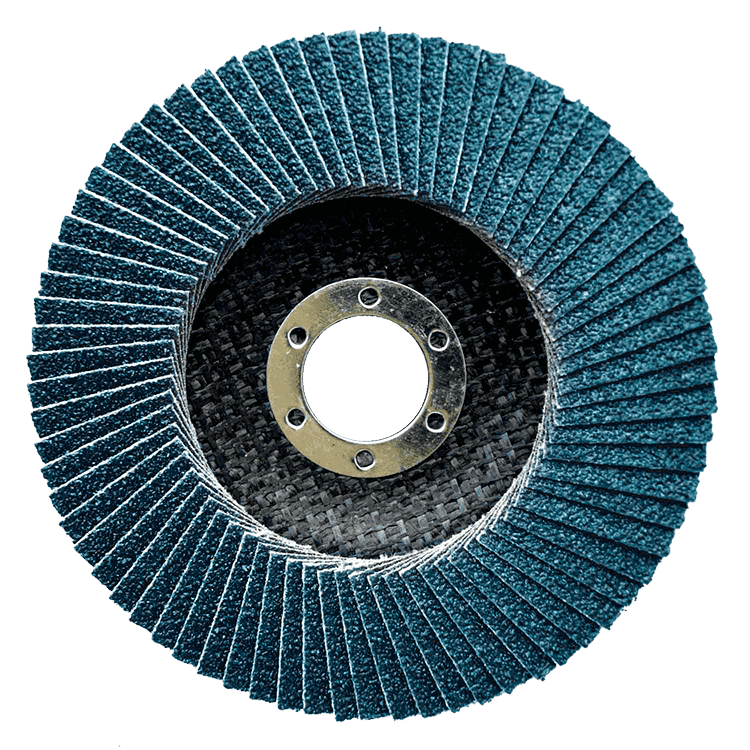
What is a flap disc?
A flap disc (also known as a flap disc or flap disc) is an abrasive tool for grinding and polishing, consisting of overlapping flaps of abrasive paper secured to a plastic or fiber backing. Unlike grinding wheels, flap discs provide a softer and more controlled finish with better surface quality.
NovoAbrasive produces flap discs in three series — Standard (corundum), Profi (zirconium) and Extreme (ceramic grain). Each series is designed for a specific load level and budget.
How to choose grit size
| Grit / Grain Size | Appointment | Result |
|---|---|---|
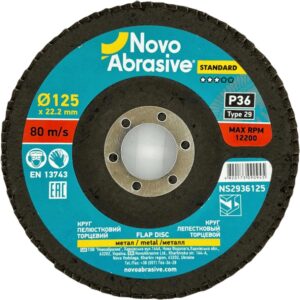
| P36–P40 | Rough metal removal, cleaning of welds | Maximum performance, rough surface |
| P60 | Surface cleaning, paint and rust removal | Medium roughness, balance of performance |
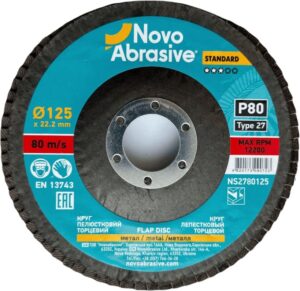
| P80 | Preparation for painting, leveling | Smooth surface, good paint adhesion |
| P100–P120 | Finishing sanding, preparation for priming | Almost mirror surface |
Tip: Start with a coarser grit and gradually move to a finer one. For example: weld seam - P40, then P60, then P80 to prepare for painting.
Types of abrasive grain
Ceramic grain (EXTREME series)
The most productive type. The microstructure of the ceramic ensures continuous self-sharpening under load. The resource is 2–3 times greater than zircon. Ideal for industrial volumes and hard alloys.
Zircon (PROFI series)
Optimal price/life ratio. Self-sharpening under load, works without clogging. Recommended for daily professional work, stainless steel and hard metals.
Corundum (STANDARD series)
Aluminum oxide is a classic abrasive. Affordable price, sufficient resource for household and infrequent work. Well suited for carbon steel and general grinding.
T27 vs T29 — which shape to choose
| Parameter | T27 (flat) | T29 (tapered) |
|---|---|---|
| Working angle | 0–15° | 15–25° |
| Best for | Finishing, polishing | Seam cleaning, metal removal |
| Contact area | Larger (surface grinding) | Smaller (more aggressive removal) |
| Recommendation | Flat surfaces, sheet metal | Welds, angles, profiles |
Rule: If you work mainly at an angle (welds, corners) - T29. If you grind surfaces - T27.
Product series
EXTREME — Industrial Series
Ceramic grain, maximum resource and productivity. For industrial volumes: shipbuilding, railcar construction, metal construction. Grit size P36–P80.
PROFI — Professional series
Zirconium and corundum. Optimal price/quality ratio for everyday work. Grit size P40–P120. The widest range of shapes and sizes.
STANDARD — Economy series
Corundum. A reliable solution for household and infrequent work. Grit size P40–P120. Brands: NovoAbrasive Standard, Getman.
For what work to use
- Weld cleaning— P36–P60, zirconia or ceramic, T29
- Rust and scale removal— P40–P60, any grit type
- Paint and Coating Removal— P60–P80, T29
- Welding preparation— P40–P60, zircon
- Preparation for painting— P80–P120, T27
- Stainless steel processing— P60–P120, zirconia or ceramic only
- Deburring— P60–P80, T29
- Edge profiling— P40–P60, T29
Technical specifications
| Diameter | 115 mm, 125 mm |
| Bore | 22.23 mm |
| Form | T27 (flat), T29 (tapered) |
| Max speed | 80 m/s (12,200 rpm for 125 mm) |
| Grit / Grain Size | P36, P40, P60, P80, P100, P120 |
| Abrasive grain | Ceramics / Zirconium (ZA) / Corundum (AO) |
| Base | Fiber / Plastic |
| Standard | EN 13743 |
| Expiration date | 3 years from date of manufacture |
Petal wheels - full catalog
Filter by parameters or use search
 EXTREME
 EXTREME
 EXTREME
 EXTREME
 EXTREME
 EXTREME
 EXTREME
 EXTREME
 EXTREME
 EXTREME
 EXTREME
 EXTREME
 PROFI
PROFI PROFI
PROFI PROFI
PROFI PROFI
PROFI PROFI
PROFI PROFI
PROFI PROFI
PROFI PROFI
PROFI PROFI
PROFI PROFI
PROFI PROFI
PROFI PROFI
PROFI PROFI
PROFI PROFI
PROFI PROFI
PROFI PROFI
PROFI PROFI
PROFI PROFI
PROFI PROFI
PROFI PROFI
PROFI PROFI
PROFI PROFI
PROFI PROFI
PROFI PROFI
PROFI STANDARD
 STANDARD
 STANDARD
 STANDARD
 STANDARD
 STANDARD
 STANDARD
 STANDARD
 STANDARD
 STANDARD
 STANDARD
 STANDARD
 STANDARD
 STANDARD
 STANDARD
 STANDARD
 STANDARD
 STANDARD
 STANDARD
 STANDARD
 STANDARD
 STANDARD
 STANDARD
 STANDARD
Useful guides and categories
Articles and instructions for choosing the right flap discs
Need a wholesale price for flap discs?
Leave a request - our manager will contact you during the working day.
Request wholesale price
Sales department
Frequently asked questions
How is a flap disc different from a sweep disc?
The flap wheel consists of overlapping flaps of sanding paper and works softer. The finishing wheel is a monolithic abrasive disc 6–8 mm thick, designed for rough metal removal. The flap wheel gives better surface quality, heats the part less, and creates less vibration and noise.
What grit should I choose for cleaning a weld?
For rough weld cleaning, start with P40 (or P36 for large welds). For finishing before painting, move to P80. For decorative stainless steel, P60, then P120.
Ceramics, zirconium or corundum - what to choose?
Ceramic (Extreme) — for industrial volumes, maximum resource. Zircon (Profi) — for daily professional work, optimal price/quality ratio. Corundum (Standard) — for household tasks and infrequent work. For stainless steel — only zircon or ceramic.
T27 or T29 — which shape to choose?
T27 (flat)— for surface grinding at an angle of 0–15°. Provides uniform processing of large surfaces. T29 (tapered)— for work at an angle of 15–25°. More aggressive metal removal, better for welds and corners. If you need one universal wheel — choose T29.
At what angle should you work with a flap wheel?
The recommended angle of inclination is 15–25° to the surface for T29 and 0–15° for T27. Unlike grinding wheels (30–40°), flap wheels work more effectively at a lower angle. Do not press too hard - let the abrasive do the work.
How much does a petal circle cost wholesale?
Wholesale prices depend on the series, grain size and order volume. We offer discounts from 22% for orders over UAH 5,000, to 38% for orders over UAH 50,000. Leave a request using the form above — the manager will prepare an individual offer.
Can I use a flap disc on wood?
Yes, but only P80 grit and finer. Coarse grits (P40) tear the wood fibers. Work at low speed and at a minimum angle. For soft rocks, it is better to use special grinding discs.