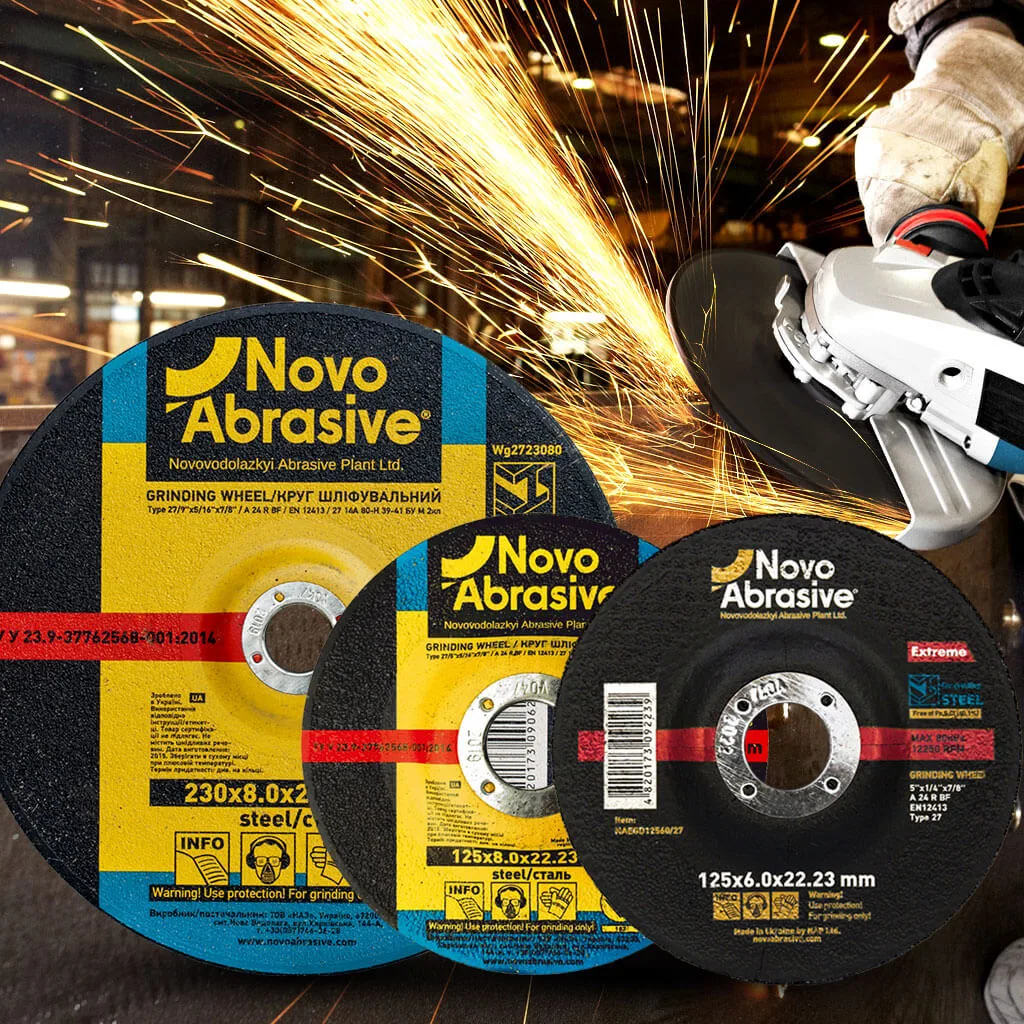
Types of Grinding discs: grinding, flap, fiber
Grinding with a grinder is not just about Grinding discs. There are several types of tools, each optimized for a specific task. Understanding the differences will help you choose the right wheel and save you time and money.
Strip discs (Type 27 / Type 28)
A thick, hard disc 4–8 mm thick, reinforced with glass mesh. Designed for rough, aggressive metal removal. The Grinding disc operates with the side surface at an angle of 15–30° to the workpiece. This is the main tool for removing welds, scale, burrs and corrosion.
- Type 27— flat profile, for working with the disk plane
- Type 28— dished (bent), more convenient for processing corners and welded joints
Flap Discs
A disc made of layered flaps of sanding paper on a hard or plastic backing. A flap wheel is a versatile tool that combines the functions of deburring and sanding. The flaps bend under load, which provides a soft and even finish.
- Grits from P40 to P120 - a wide range of tasks
- Lower vibration compared to a Grinding disc
- Quieter operation, more controlled process
Fibre discs
A thin, flexible disc with an abrasive coating on a fiber base. It is mounted on the grinder through a special backing pad. The fiber wheel is ideal for contouring, paint removal and working on curved surfaces.
- The finest finish among all types
- Works on large surfaces without overheating
- Requires a support plate for installation
Wire cup brushes
They are not abrasive tools in the classical sense, but are often used for grinding tasks: removing rust, old paint, scale. They are made of steel and brass wire, twisted or corrugated.
When to use what - task table
Choose the type of wheel depending on the task. Using the right tool saves time and gives better results:
| Task | Recommended type | Grit / Grain Size | Note |
|---|---|---|---|
| Removing the weld seam | Grinding disc | 24–36 | Quick rough removal, then flap finish |
| stripping off scale | Strip or flap | 36–60 | Flap gives a cleaner surface |
| Preparation for painting | Flap | P60–P80 | Creates the correct roughness for adhesion |
| Rust and paint removal | Flap or fibrous | P40–P60 | fibre is better on curved surfaces |
| Edge stripping after cutting | Flap | P60–P80 | Removes burrs, smoothes the edge |
| Finishing before priming | Fibrous or flap-like | P80–P120 | Uniform matte surface |
| Removing large allowances | Grinding disc | 24 | Fastest metal removal |
Choosing the grit for sanding
The grit determines how coarse or fine the surface will be. The lower the number, the coarser the grain and the more aggressive the removal. The higher the number, the finer the finish.
| Grit / Grain Size | Processing type | Where to use | Surface roughness |
|---|---|---|---|
| P24–P36 | Rough removal | Weld seams, large allowances, scale | Rough - visible scratches |
| P40–P60 | Medium grinding | Rust removal, preparation, edges | Medium - barely noticeable scratches |
| P80 | Finishing grinding | Preparation for painting | Smooth - matte surface |
| P100–P120 | Finishing | Before priming, decorative work | Thin - semi-gloss surface |
Selection for finishing material
Different materials require different abrasives. The wrong choice reduces productivity and can ruin the workpiece.
| Material | Grain type | Recommended disc | Feature |
|---|---|---|---|
| Structural steel | Aluminum oxide (A) or zirconium (ZA) | Strip or flap | The most common option, without restrictions |
| Stainless steel (INOX) | Zirconia or ceramic, INOX marking | Flap INOX or fiber INOX | Without Fe and S to prevent corrosion |
| Aluminum | Silicon carbide (C) or special A | Flap with zinc stearate | Stearate prevents clogging of flaps |
| Tree | Aluminum oxide | Flap or fibrous | Low RPM, P60–P120 |
| Stone, concrete | Silicon carbide (C) | Clearing (C) or diamond cup | For large areas, diamond is more effective. |
Correct working angle
The angle of inclination of the grinder to the surface is a critical parameter. It determines the productivity, quality of processing, and resource of the wheel.
| Disc type | Working angle | What happens at the right angle? | Errors |
|---|---|---|---|
| Grinding disc | 15–30° | Maximum removal, even wear | At >40° — overheating, at |
| Flap Disc | 5–15° | Flaps bend, uniform finish | At >20° — rapid wear of the flap tips |
| Fiber disc | 10–15° | Full contact area with the support plate | At >20° - uneven wear, waviness |
NovoAbrasive abrasive products
NovoAbrasive produces a full range of grinding tools for grinders. All products are certified according to EN 12413 and have passed 6-stage quality control at the factory in Nova Vodolaz (Kharkiv region). Full catalog of 125 mm flap discs with series comparison and grit filter.
All NovoAbrasive grinding wheels are made from European raw materials (Austria, Germany) on Davide Maternini equipment (Italy). The products are certified by MPA Hannover — NovoAbrasive is the only Ukrainian manufacturer with this certification.
Frequently asked questions
What is the difference between a Strip disc and a flap wheel?
Grinding disc (Type 27/28, thickness 4–8 mm) — for rough removal of metal, welds, scale. Works at an angle of 15–30°. Flap wheel — for finishing, grinding and surface preparation. Works at an angle of 5–15°. Flap wheel gives a cleaner surface, Grinding disc — removes metal faster.
What grit should I choose for grinding metal?
P40 - rough removal of metal, welds, scale. P60 - universal grit for most jobs. P80 - surface preparation before painting. P120 - finishing before priming. Start with a coarser grit and work your way down to a finer grit.
At what angle should you work with a flap wheel?
The optimal angle for a flap disc is 5–15° to the surface. Too large an angle will lead to rapid wear of the flaps and uneven finishing. An angle of 10–15° achieves the best ratio of productivity and surface quality.
Can I polish stainless steel with a regular Strip disc?
How many flap discs are needed to clean 1 m² of surface?
Depends on the grain size and surface condition. On average, one 125 mm diameter P60 flap disc covers 3–5 m² of metal surface when removing light rust. For rough stripping of welds, the consumption is higher - approximately 1–2 m² per disc.
Need help choosing?
Use our Product Finder or get technical advice