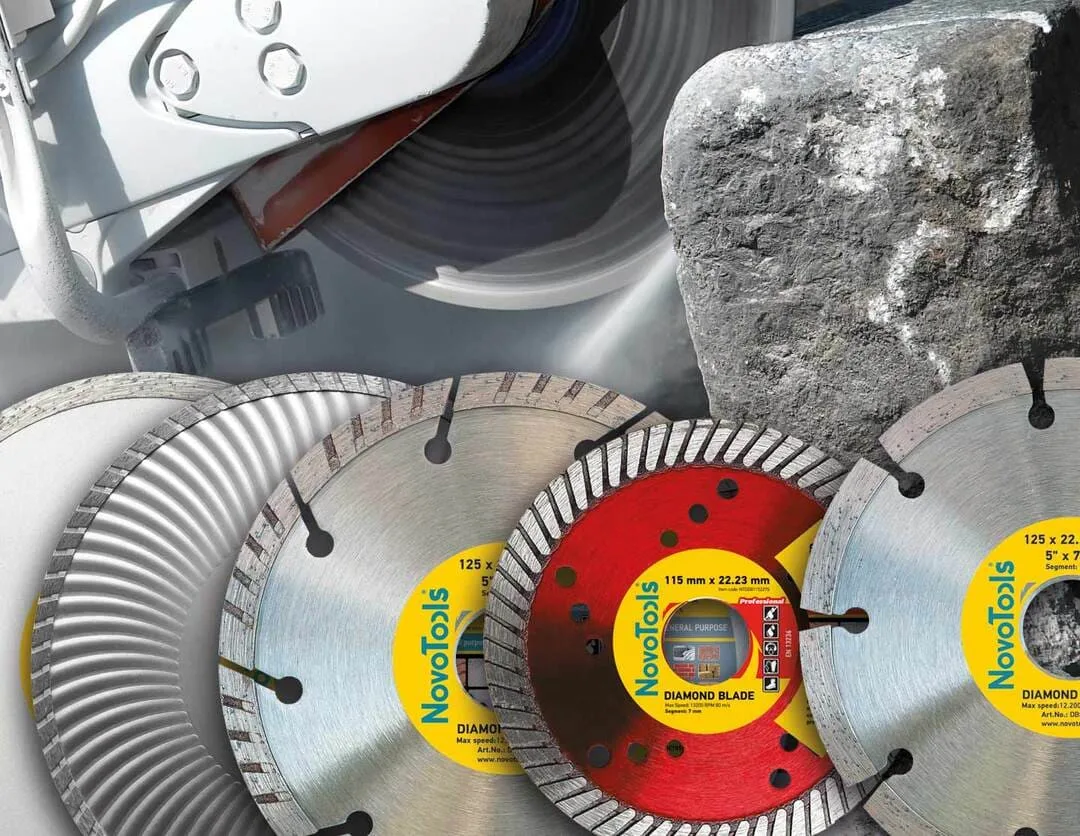
What is a diamond blade and how does it work?
A diamond cutting disc is a tool for cutting hard mineral materials: concrete, stone, brick, ceramics, granite. Unlike abrasive wheels, a diamond disc does not wear out - it cuts thanks to technical (synthetic) diamonds fixed in a metal bond around the perimeter of a steel body.
The design consists of three components:
- Steel body - the base of the disc, made of special hardened steel. Provides rigidity and transfers rotation from the grinder to the cutting segments.
- A diamond segment is a cutting element containing synthetic diamonds of various fractions. Diamond is the hardest material, so it is capable of cutting any stone or concrete.
- The bond (matrix) is a metal alloy that holds the diamond grains. The composition of the bond determines the materials for which the disc is intended: soft bond for hard materials (granite), hard bond for soft materials (brick).
Working principle: during rotation, diamond grains scratch and micro-chip the material. Gradually, the bond wears out, exposing new diamonds - the disc is self-sharpening. Therefore, a high-quality diamond disc maintains its performance throughout its service life.
Three types of diamond blades
Diamond cutting discs differ in the shape of the cutting edge (rim). Each type is optimized for its tasks and materials.
Segmented
The cutting edge is divided into separate segments with slots between them. The slots perform two functions: they cool the blade with air and remove sludge (dust) from the cutting area.
- Advantages: fastest cutting, effective air cooling, works without water supply, best durability
- Disadvantages: rougher cut, possible small chips on the edges
- Ideal for: concrete, brick, cinder block, stone, wall studs. Dry cutting possible
Continuous Rim
Continuous cutting edge without slots. Gives the cleanest and most accurate cut without chips, but requires a mandatory water supply for cooling.
- Advantages: cleanest cut without chips, perfect edge, minimal dust formation with water
- Disadvantages: mandatory water supply, slower cutting, overheats without cooling
- Ideal for: ceramic tiles, porcelain stoneware, porcelain stoneware. Requires water
Turbo
The wave-shaped (turbine) edge combines the advantages of segmented and solid discs. It can work both dry and with water supply.
- Advantages: versatility, good cut quality, works dry and wet, fast cutting
- Disadvantages: cut not as clean as solid; not as fast as segmented on concrete
- Ideal for: concrete, brick, ceramic, granite - universal use
| Parameter | Segmental | Solid | Turbo |
|---|---|---|---|
| Concrete cutting | ★★★★★ | ★★☆☆☆ | ★★★★☆ |
| Tile cutting | ★★☆☆☆ | ★★★★★ | ★★★☆☆ |
| Granite cutting | ★★★☆☆ | ★★★★☆ | ★★★★★ |
| Speed | ★★★★★ | ★★★☆☆ | ★★★★☆ |
| Clean cut | ★★★☆☆ | ★★★★★ | ★★★★☆ |
| Resource | ★★★★☆ | ★★★★☆ | ★★★★★ |
| Dry cutting | ✔ | ❌ | ✔ |
| Wet cutting | ✔ | ✔ | ✔ |
Step 1 — Determine the cutting material
This is the most important selection criterion. Different materials have different hardness and structure, so they require different types of diamond discs and bonds.
| Material | Recommended type | Note |
|---|---|---|
| Concrete | Segmental or turbo | Dry cutting. For reinforced - a disc with a high concentration of diamonds |
| Ferroconcrete | Segmental (special) | You need a disc marked "for reinforced concrete" - softer bond |
| Brick | Segmental | Soft material - any segment disc will do |
| Ceramic tiles | Solid (wet) | Wet cutting only. Solid rim provides a chip-free cut |
| Porcelain stoneware | Solid (wet) | Harder than ceramic — you need a quality disc. Wet cutting |
| Granite, marble | Turbo or continuous | Granite is very hard - soft bond. Marble is soft - solid. |
| Paving slabs | Segmental or turbo | Dry cut. Abrasive material - standard segmented |
| Slate | Solid | Brittle material - requires a smooth cut without vibrations |
Step 2 — Choose a diameter
The diameter of the diamond disc should match the power of your grinder. The most popular sizes in Ukraine are 125 mm and 230 mm.
| Diameter | Depth of cut | Power of the grinder | Typical tasks |
|---|---|---|---|
| 115 mm | up to 25 mm | 700–1000 W | Tiles, small jobs, trimming |
| 125 mm | up to 30 mm | 800–1200 W | Universal: tile, brick, strobes, concrete (most popular) |
| 150 mm | up to 40 mm | 1200–1500 W | Brick, concrete, paving slabs |
| 180 mm | up to 50 mm | 1500–2000 W | Concrete walls, curbs, blocks |
| 230 mm | up to 65 mm | from 2000 W | Heavy work: concrete slabs, demolition, asphalt |
Step 3 — Dry or Wet Cutting
The method of cooling the blade during operation is an important factor affecting its service life, cut quality, and safety.
Dry cutting
The disc is cooled by air through the slots between the segments. The most convenient way for a hand grinder.
- No additional equipment required — just a grinder and a disc
- Convenient to work anywhere, even without water and electricity
- Suitable for segment and turbo discs
- More dust - mandatory FFP2 respirator
- Shorter disk life due to increased heating
Wet cutting
Water is supplied to the cutting area through a special nozzle or on a tile cutter. The water cools the disc and washes away sludge.
- Disk life increases 2–3 times due to effective cooling
- Dust generation is reduced by 90% - safer for health
- The cleanest cut — a must for ceramics and porcelain stoneware
- Requires water supply or tile cutter with bathtub
- Solid discs work ONLY with water supply
What to look for when buying
In addition to type and diameter, there are several other important parameters that are worth checking before buying a diamond blade:
- Segment height (7–10 mm)— the higher the segment, the longer the disc lasts. The standard height is 7–10 mm. Cheap discs have segments of 5–6 mm, which reduces the service life by 1.5–2 times.
- Number of segments - more segments means a smoother cut, but slower slag removal. Fewer segments means faster cutting, but a coarser cut.
- Type of bond - for hard materials (granite, porcelain stoneware) a soft bond is required, for soft materials (brick, limestone) a hard bond is required. Principle: hard cuts soft, soft cuts hard.
- Maximum speed is indicated on the disc in m/s and RPM. The speed of the grinder should not exceed the maximum permissible speed of the disc.
- Bore (22.23 mm standard)— standard for grinders: 22.23 mm. For stationary machines — 25.4 or 32 mm. Check compliance.
- The EN 13236 marking is the European standard for diamond tools. A disc with this marking has been tested for safety and performance. Choose only certified discs.
Common mistakes
- Cutting metal with a diamond blade. The most dangerous mistake. The metal clogs the diamond segments, the blade overheats and can deform. For metal, use only abrasive cutting discs.
- Solid disc for concrete. A solid disc without water supply overheats in seconds - the body deforms, the segments are soldered. For dry cutting of concrete, use only segment or turbo.
- Segmented tile blade. The slots between the segments cause vibrations that can chip fragile ceramics. A solid wet-cutting blade is required for clean tile cutting.
- Dry cutting of tiles. Even a turbo disc without water will chip the ceramic. For a fine cut of tiles, water supply is mandatory - use a tile cutter or a grinder attachment.
- Cutting with pressure. The diamond blade cuts by itself - you just need to guide the grinder. Pressure overloads the motor, overheats the segments and causes an uneven cut. Let the blade run.
- Ignoring dust (FFP2/FFP3 respirator). Concrete and stone dust contains silica (SiO₂), which causes silicosis, an incurable lung disease. Always work in an FFP2 or FFP3 respirator and use wet cutting where possible.
NovoAbrasive diamond discs
NovoAbrasive produces a complete line of diamond cutting discs for all types of mineral materials:
All NovoAbrasive diamond discs comply with EN 13236 standard and undergo 6-stage quality control. Manufactured on Davide Maternini (Italy) and ABRAPRESS equipment using European diamond powders.
Frequently asked questions
Which diamond blade should I choose for cutting tiles?
For ceramic tiles, choose a solid diamond blade with wet cutting (water supply). The continuous cutting edge gives a clean cut without chips. For porcelain stoneware, a high-quality solid blade or turbo with wet cutting is also suitable. A segmented blade for tiles is not recommended - it gives chips at the edges.
Can you cut metal with a diamond blade?
No, it is strictly prohibited. The diamond blade is intended only for mineral materials (concrete, stone, ceramics). The diamond burns from friction on metal - the segments overheat, the blade deforms, which creates a danger for the operator. Use abrasive cutting discs to cut metal.
Segmented or turbo - what to choose for concrete?
Both types are suitable for concrete. Segmented cuts faster due to better slag removal - choose for large volumes and rough cutting. Turbo gives a smoother, cleaner cut and is more versatile - suitable if you also plan to cut brick, tile or granite.
How many meters does one diamond blade cut?
Depends on the material, diameter and quality of the disc. A high-quality 125 mm diamond disc cuts an average of 20–50 linear meters of concrete with a cutting depth of 50 mm. Wet cutting increases the resource by 2–3 times. For comparison: an abrasive stone wheel of the same diameter cuts only 3–5 m.
Why did the diamond blade stop cutting?
Three main reasons: glazing - diamonds are sunk into the bond and do not protrude (make several cuts on the abrasive material - brick, cinder block); overheating - deformation of the housing from working without pauses or without water; wear of segments - the segment height is less than 1–2 mm, the disc needs to be replaced.
How to store diamond blades?
Store diamond discs in a dry place, horizontally or on special hangers. Avoid hitting the segments - this can damage the soldering. Do not store together with metal tools. Unlike abrasive wheels, diamond discs do not have an expiration date - their service life is determined by the wear of the segments.
Choose a diamond blade
NovoAbrasive diamond cutting discs catalog: segmented, solid and turbo