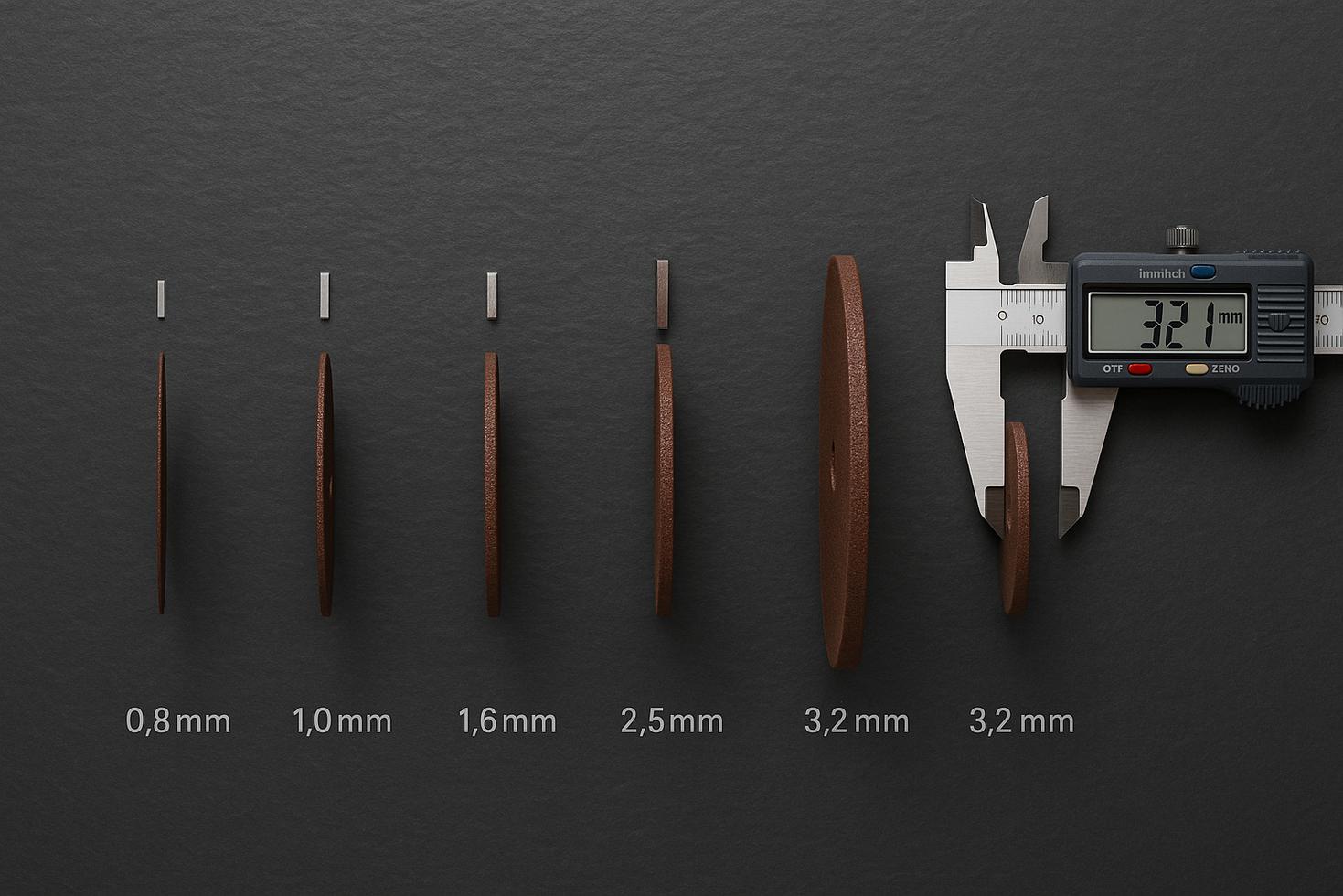
Why thickness matters
The thickness of a cutting disc is not just a size. It directly affects four key performance parameters:
- Cutting width - a thinner disc removes less material, leaving a narrower gap. This means less waste and a more accurate cut
- Workpiece heating - a thinner wheel creates less friction and therefore less heat. Critical for stainless steel, thin sheet metal and hardened steels
- Disc life - a thicker disc contains more abrasive material and makes more cuts before it is completely worn out
- Cutting speed - a thinner disc cuts faster because it removes less material in one pass
Complete thickness table
Here are all the standard thicknesses of Cutting discs that are manufactured according to EN 12413, with application recommendations:
| Thickness | Category | Appointment | Cutting width | Heating |
|---|---|---|---|---|
| 0.8 mm | Ultra-thin | Thin sheet metal up to 1.5 mm, precision cuts | ~0.9 mm | Minimum |
| 1.0 mm | Thin | Sheet metal, profile, pipes up to 20 mm, INOX | ~1.1 mm | Very low |
| 1.2 mm | Thin | Pipes, fittings up to 14 mm, profiles | ~1.3 mm | Low |
| 1.6 mm | Thin | Fittings up to 18 mm, pipes, medium-section rolled products | ~1.7 mm | Moderate |
| 2.0 mm | Standard | 16-25 mm fittings, thick-walled pipes | ~2.2 mm | Average |
| 2.5 mm | Standard | Large cross-sections, profile from 20 mm, difficult tasks | ~2.7 mm | Increased |
| 3.0 mm | Thick | Stationary machines, large cross-section, rails | ~3.2 mm | High |
| 3.2 mm | Thick | Stationary machines, gas cutters, rail cutters | ~3.5 mm | High |
Thin discs (0.8-1.6 mm)
Thin cutting discs are the modern standard for handheld angle grinders. They have gradually replaced thick discs in most applications due to a number of advantages:
Advantages of thin discs
- Faster cutting - less material to remove means less time per cut. 1.0 mm disc cuts up to 40% faster than 2.5 mm
- Less heat is critical for stainless steel (INOX), thin sheet metal and galvanizing. Less heat means less deformation and runout
- Less effort— less pressure is required, the grinder is less stressed, the operator is less tired
- Narrower cut— less material waste, more precise cut line
Limitations of thin discs
- Shorter life - a thinner disc contains less abrasive, so it makes fewer cuts before it is completely worn out
- Sensitivity to lateral loads - do not allow swaying or tilting. The cut must be strictly perpendicular
- Not for large cross-sections - a 1.0 mm disc can "get stuck" in a deep cut of thick reinforcement
Standard (2.0-2.5 mm)
Discs with a thickness of 2.0-2.5 mm occupy an intermediate position. They have a longer resource than thin ones, but cut more slowly and heat the workpiece more.
When to choose standard thickness
- Large cross-sections - reinforcement from 16 mm, thick-walled pipes, I-beams, channels
- Large volume of the same type of work - when it is important to reduce the number of disc replacements. One 2.5 mm disc replaces 2-3 1.0 mm discs in terms of the number of cuts
- Stationary work - on a stand or in a vice, where there is no risk of lateral load
- Less experienced operators– a thicker disc is more stable and forgiving of minor errors in technique
Thick (3.0+ mm)
3.0-3.2 mm thick wheels are specialized tools for specific tasks. They are rarely used on hand grinders and are intended mainly for stationary equipment. Before using any wheel, check the permissible revolutions (RPM) - they depend on the diameter.
Where thick discs are used
- Cutting machines - pendulum and stationary, where disc rigidity is required with a large cutting depth
- Gasoline cutters (shtils) - for cutting pipes, rails, concrete on the go. Diameter 300-400 mm
- Rail cutters - specialized 400 mm discs for cutting railway rails. Three-layer reinforcement, speed up to 100 m/s
- Large metal cross-sections - beams, channels, large diameter pipes on powerful grinders 230 mm and more
| Parameter | Thin (1.0 mm) | Standard (2.5 mm) | Thick (3.2 mm) |
|---|---|---|---|
| Cutting speed | Highest | Medium | Lower |
| Heating | Minimum | Average | Maximum |
| Resource (number of cuts) | Less | Average | Most |
| Cutting width | ~1.1 mm | ~2.7 mm | ~3.5 mm |
| For INOX | So | No | No |
| Resistance to lateral load | Low | High | Highest |
Relationship between diameter and thickness
Not every thickness is available for every diameter. There are typical combinations optimized by manufacturers for specific applications:
| Diameter | Typical thicknesses | Most popular | Comment |
|---|---|---|---|
| 115 mm | 1.0, 1.2, 1.6 | 1.0 mm | Small diameter - only thin discs |
| 125 mm | 0.8, 1.0, 1.2, 1.6, 2.0, 2.5 | 1.0 mm | The widest range of thicknesses |
| 150 mm | 1.2, 1.6, 2.0 | 1.6 mm | Average diameter, average thickness |
| 180 mm | 1.6, 2.0, 2.5 | 2.0 mm | For powerful Bulgarians |
| 230 mm | 1.6, 2.0, 2.5, 3.0 | 2.0 mm | Large diameter - rigidity required |
| 300-400 mm | 2.5, 3.0, 3.2 | 3.0 mm | Stationary machines and chainsaws |
Frequently asked questions
What thickness of cutting disc should I choose for a 125 mm grinder?
For a 125 mm grinder, the optimal thickness is 1.0-1.6 mm. A 1.0 mm disc is for thin sheet metal, profiles and stainless steel (fastest cut, minimum heating). A 1.6 mm disc is for fittings up to 16 mm and pipes (balance of speed and resource). A 2.5 mm thickness is justified only for large cross-sections.
Does a thin 1.0 mm disc cut slower than a thick 2.5 mm disc?
On the contrary, a thin disc cuts faster. It removes less material (narrower cut), so it requires less energy and time. In addition, a thin disc heats the workpiece less. A thick disc cuts slower, but has a longer life (number of cuts).
Why do thin 1.0 mm discs wear out faster?
A thinner disc contains less abrasive material, hence a shorter service life. But this is compensated by the cutting speed: one cut with a thin disc takes less time and uses less disc material than with a thick one. For most tasks, a thin disc is more economical in terms of time.
Why are discs with a thickness of 3.0-3.2 mm needed?
3.0-3.2 mm discs are intended for stationary cutting machines and gas cutters, where maximum resource and rigidity of the disc are required. On hand grinders, their use is justified only for cutting large cross-sections (reinforcement from 20 mm, thick-walled pipes) on powerful machines from 2000 W.
Choose a NovoAbrasive cutting disc
211 cutting disc items in three series — Standard, Profi and Extreme. From 0.8 to 3.2 mm.