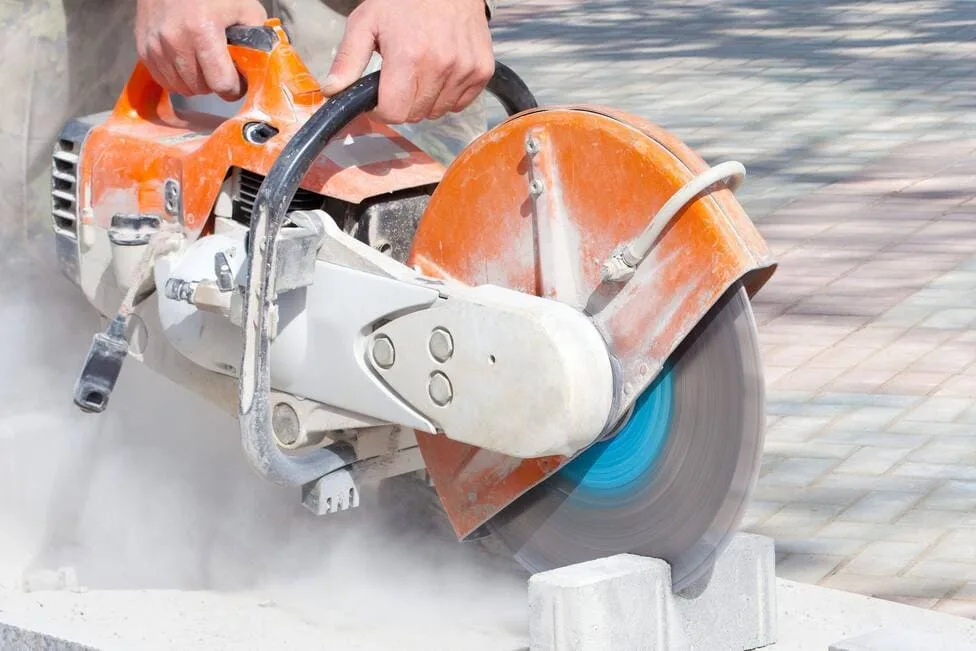
Two approaches to cutting stone
Cutting concrete, stone, brick and ceramics is one of the most common tasks in construction and renovation. There are two fundamentally different types of tools for this:
- Abrasive discs for stone are the traditional approach. Discs on a bakelite bond with silicon carbide (SiC) grain, marked C according to EN 12413. Affordable, but wear out quickly.
- Diamond cutting discs are a modern approach. Steel body with segments containing technical diamonds. Much more durable, but more expensive per unit.
Both approaches have their place. Let's take a look at when to choose which one.
Abrasive discs for stone
Abrasive discs for stone are visually similar to discs for metal, but have a different formulation. The main grain is silicon carbide (SiC), which is much harder than aluminum oxide and is capable of cutting mineral materials.
When to choose an abrasive disc
- One-time work - you need to make several cuts in brick or concrete during repairs
- Limited budget - an abrasive disc costs 5-10 times less than a diamond disc
- Small volume - up to 5-10 linear meters of cutting
- There is no grinder with water supply - abrasive discs always work dry
Limitations of abrasive discs
- They wear out quickly - one 230 mm disc makes only 3-5 linear meters of concrete cut
- Decrease in diameter during operation - cutting depth decreases
- Significant dust generation and heating
- Wider cut (3.0-3.2 mm) — more material waste
Diamond cutting discs
A diamond blade is a steel body with segments soldered around the perimeter, containing technical (synthetic) diamonds in a metal bond. Diamond is the hardest material, so it cuts any stone without problems.
When to choose a diamond blade
- Large volumes - from 10 linear meters of cutting
- Regular work - construction, tiling, dismantling
- A precise cut is needed - a diamond gives a smooth edge without chips
- Hard materials - granite, marble, porcelain stoneware
- Minimal dust generation– especially with water supply
Advantages of diamond blades
- Lifespan 50-100 times higher than an abrasive disc
- Stable diameter - cutting depth does not decrease
- Narrower cut (2.0-2.4 mm) — less waste
- Less heating of the workpiece when used correctly
- Lower cost per linear meter of cut
Comparison table
| Parameter | Abrasive disc | Diamond disc |
|---|---|---|
| Price per unit | Low (50-150 UAH) | High (300-2000 UAH) |
| Resource (cutting speed) | 3-5 m | 150-500 m |
| Cost of 1 p.m. of cutting | High | Low |
| Cut quality | Secondary, possible schooling | High, smooth edge |
| Dust generation | Very high | Moderate (minimal with water) |
| Cutting width | 3.0-3.2 mm | 2.0-2.4 mm |
| Diameter reduction | Yes, significantly | Minimally |
| Time to replace the discs | Often (every 3-5 m) | Rarely (every 150+ m) |
| Best for | One-time jobs, small budget | Regular work, large volumes |
Three types of diamond blades
Diamond cutting discs differ in the shape of their cutting edge. Each type is optimized for its own tasks:
| Disc type | Cooling | Cut quality | Speed | Materials |
|---|---|---|---|---|
| Segmental | Air (dry) | Medium | High | Concrete, brick, cinder block, paving slabs |
| Solid | Water (wet) | Highest | Medium | Ceramics, marble, porcelain stoneware, glass |
| Turbo | Air/water | High | High | Concrete, brick, ceramics, granite |
Which disc for which material
Different mineral materials have different hardness and structure. Choosing the wrong blade will result in rapid wear or poor cutting quality.
| Material | Type of diamond blade | Reese | Notes |
|---|---|---|---|
| Concrete | Segmental or turbo | Dry | For reinforced - a disc with a high concentration of diamonds |
| Brick | Segmental | Dry | Soft material, any segment disc will do |
| Granite | Turbo or continuous | Wet | Very hard - requires soft segment binding |
| Marble | Solid | Wet | Soft and brittle - only solid for a clean cut |
| Ceramic tiles | Solid | Wet | No chipping with only a solid disc with water supply |
| Porcelain stoneware | Solid or turbo | Wet | Harder than ceramic — you need a quality disc |
| Paving slabs | Segmental or turbo | Dry | Abrasive material - standard segmented material is suitable |
| cinder block | Segmental | Dry | Porous material - cuts easily, produces a lot of dust |
Safety: dust, cooling, protection
Cutting concrete and stone poses specific risks that are not present when working with metal. The main one is silica dust.
Mandatory protective equipment
- FFP2 or FFP3 respirator - at least FFP2 for one-time work, FFP3 for regular work. A cloth mask does NOT protect against silica dust
- Safety glasses - closed type, with a tight frame. Stone fragments fly at high speed
- Protective cover - mandatory on the grinder, directed from the operator
- Hearing protection - when cutting concrete, the noise level exceeds 100 dB
Wet cutting is the best protection
Water supply to the cutting zone reduces dust generation by 90%. For this purpose, there are special attachments for grinders or stationary stone cutting machines with built-in supply. An additional bonus is that water cools the disc and extends its service life by 2-3 times.
NovoAbrasive diamond tool
NovoAbrasive produces a full line of diamond tools for construction materials:
- Diamond cutting discs— 54 items. Segmented, solid and turbo discs with diameters from 115 to 350 mm. For concrete, brick, granite, ceramics, asphalt
- Diamond grinding discs— 17 items. Cups and cutters for grinding concrete floors, removing coatings, preparing surfaces
All NovoAbrasive diamond discs undergo 6-stage quality control and comply with EN 13236 standards. Manufactured on Davide Maternini (Italy) and ABRAPRESS equipment using European diamond powders.
Frequently asked questions
What is better for cutting concrete - a diamond or abrasive disc?
For one-time, small-scale jobs , an abrasive stone disc (marked C) is suitable - it is cheaper. For regular work, large volumes and precise cutting, choose a diamond disc - it lasts 50-100 times longer and gives a cleaner cut with less dust.
Which diamond blade should I choose for dry cutting concrete?
For dry cutting of concrete, choose a segmented diamond blade. The slots between the segments provide air cooling and dust removal. For reinforced concrete, a blade with a higher diamond concentration is required.
Can granite be cut with a regular diamond blade?
No, granite requires a special diamond blade with a soft bond and high diamond concentration. A regular concrete blade wears the diamond segments too quickly on hard granite. Wet cutting is recommended to reduce the temperature.
Why is there so much dust when cutting concrete and how to deal with it?
Concrete dust contains silica (SiO₂), which when inhaled causes silicosis, a dangerous lung disease. For protection, be sure to use an FFP2 or FFP3 respirator, safety glasses, and wet cutting (water supply), which reduces dust formation by 90%.
How long does a diamond disc last compared to an abrasive disc?
One 125 mm diamond disc replaces on average 50-100 abrasive discs for stone. Although the price of a diamond disc is 5-10 times higher, the cost of one linear meter of cut is much lower. In addition, you save time on changing discs.
Choose a NovoAbrasive diamond disc
54 diamond cutting disc parts for any material. EN 13236 certification.